
How to Search San Francisco County Court Records
The court's official starting point is the Case Calendar and Query page. It lists the civil case query, the civil unlawful detainer query, the criminal case query, the cumulative criminal index, and the case calendar. The civil tool covers Unlimited Civil, Limited Civil, Family Law, Probate, and Small Claims cases filed from 1987 to present. The criminal tool accepts case number, defendant name, and attorney name. Each portal sits behind a captcha gate. The court says the prompt blocks automated traffic and keeps public access open for real users.
Before starting, gather a case number if one is known. If not, prepare the full name in the court's format. For party-name searches, the official name-query rules allow lastname; lastname, firstname; or a company name. Turn off pop-up blockers because case results open in a new browser window. A PDF reader is needed for any document images that the court allows online.
- Open the case information page at sf.courts.ca.gov and pick the right portal for the case type.
- Complete the captcha prompt so the court can verify the request is from a person.
- Enter a case number, or a party name in the lastname or lastname, firstname format.
- Review the register of actions and any imaged documents the court allows for that case type.
- For copies or sealed material, send the Civil Records Request Form or the Criminal Records Request Form with payment.
Family law records have tighter rules. The register of actions opens online only when the user has a case number, and family imaged documents are not online at all. Probate estate and trust images are online from 2001 forward, but guardianship, conservatorship, and elder abuse images are not. Small claims images go online from 2008 forward. Criminal documents are not online. For those, walk into Hall of Justice Room 101 or mail a request to the Records Department at 850 Bryant Street.
The Superior Court groups every public lookup tool on a single Case Calendar and Query page. The Case Calendar and Query landing page lists the civil query, criminal query, calendar, and the cumulative criminal index in one table.
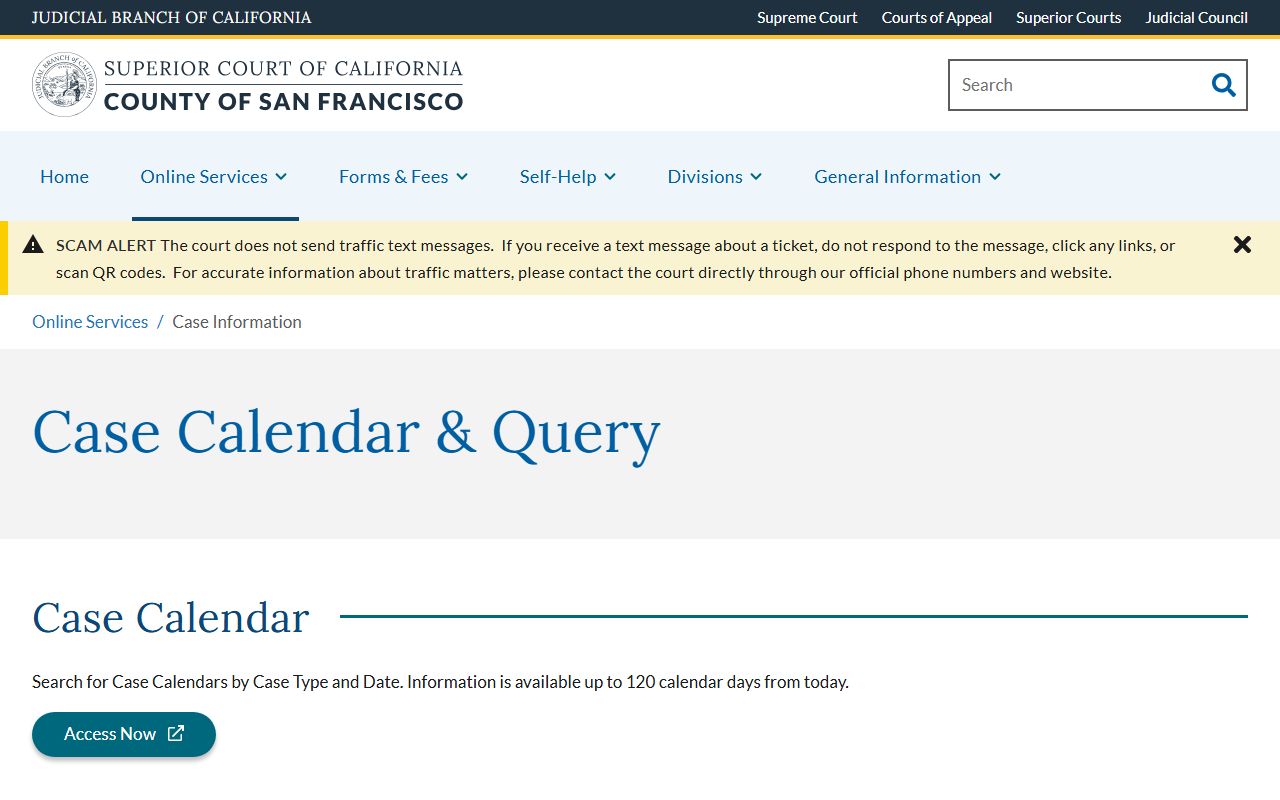
Pick the right tool from that page before running a San Francisco County court records search, because each portal handles a different case type.
The San Francisco County Judicial System
California has three levels of state court. There are 58 superior courts, one in each county. There are six Court of Appeal districts. The California Supreme Court sits at the top. Before 1998, counties ran separate superior and municipal courts. Proposition 220 let counties unify those trial benches. San Francisco's local court is now the Superior Court of California, County of San Francisco. It is the only county-level trial court in the city. There are no justice courts, county courts at law, district courts, or municipal courts at the local level.
Appeals from San Francisco Superior Court go to the California Court of Appeal, First Appellate District, headquartered in San Francisco. From there a case may seek review at the California Supreme Court. Federal cases run on a separate track through the U.S. District Court for the Northern District of California, with appeals to the Ninth Circuit. When someone uses the phrase "San Francisco district court," they usually mean the federal court, not a local trial court.
State case flow: Superior Court › Court of Appeal, First Appellate District › California Supreme Court
The court publishes services, divisions, and news on a single front-door site. The Superior Court of California, County of San Francisco home page shows the unified trial court layout and links into every division.
That home page is the safest landing spot for anyone new to the San Francisco County court records system, since third-party URLs often go stale.
| Court | Jurisdiction | Case Types |
|---|---|---|
| Superior Court of California, County of San Francisco | Unified county trial court | Civil, criminal, family, probate, juvenile, traffic, small claims, specialty |
| Court of Appeal, First Appellate District | Intermediate appeals | Appeals from San Francisco Superior Court |
| California Supreme Court | Discretionary state review | Important state law questions, death penalty review |
| U.S. District Court, Northern District of California | Federal trial court | Federal civil, criminal, and federal-question cases |
San Francisco County Courthouses
The Superior Court runs from four buildings, not one. The Civic Center Courthouse at 400 McAllister Street is the main civil, family, probate, traffic, and self-help building. It opened in 1998 after the 1989 Loma Prieta earthquake forced the court out of its old City Hall location. The Hall of Justice at 850 Bryant Street is the primary criminal courthouse and holds many traffic calendars. The Juvenile Justice Center sits at 375 Woodside Avenue. The Polk Street Annex at 575 Polk Street houses the Community Justice Center, Drug Court, and Veterans Court.
Civic Center Courthouse hours run Monday through Friday, 8:15 a.m. to 5:00 p.m. The filing clerk offices in Rooms 103 and 402 are open 8:30 a.m. to 4:00 p.m. and close for lunch from noon to 1:00 p.m. Civil Records sits in Room 103. The ACCESS Legal Self-Help Center is in Room 509. Unified Family Court is on the 4th floor. Jury Services is on the lower level in Rooms 007 and 008. Each building has its own front-desk phone and screening setup.
Civil filings, civil case files, and most copy requests go through Room 103 on the first floor. The court's Civil Records page lists the Room 103 address, the public viewing hours, and the email for record requests.
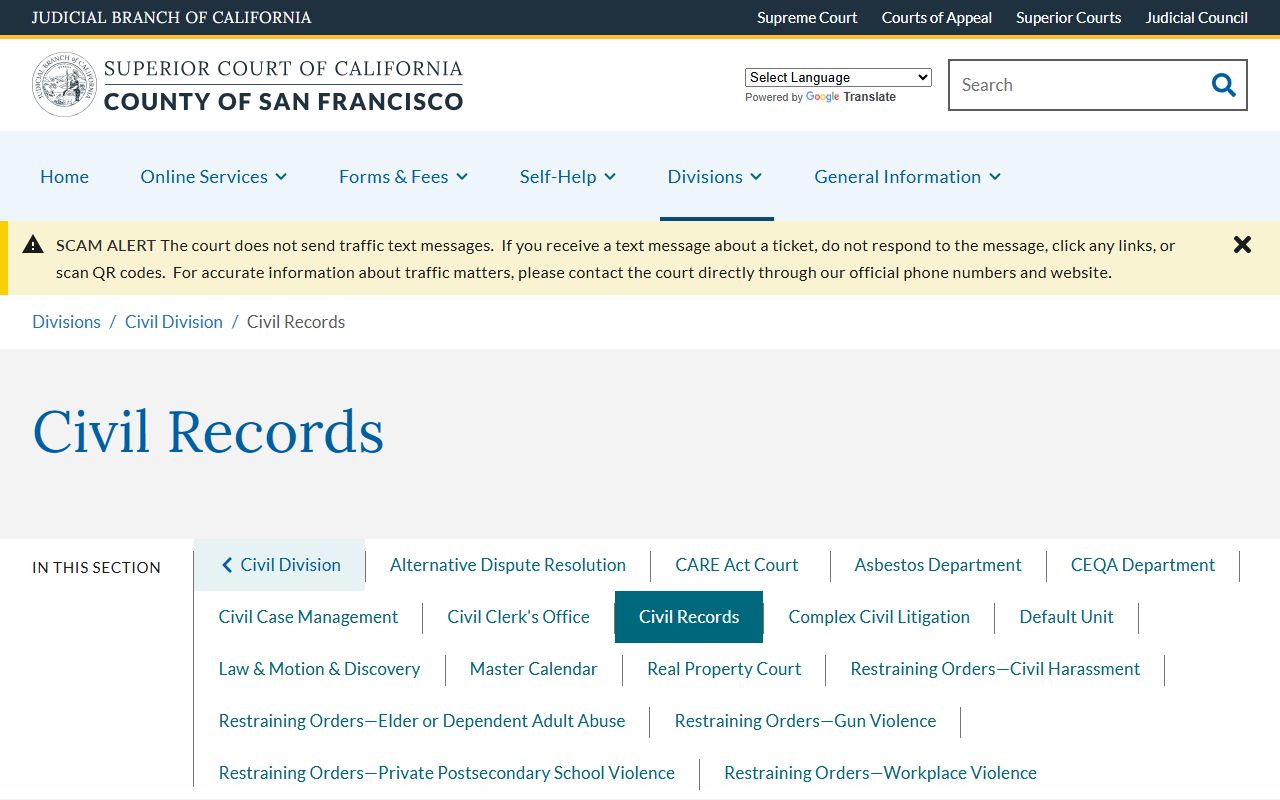
Use that page to confirm hours and copy timing before walking into the courthouse for a San Francisco County court records pull.
Types of San Francisco County Court Records
The Superior Court keeps records across many case types. Each type sits in a different division and has its own access rules. Civil records cover lawsuits, contract disputes, personal injury, civil harassment, civil restraining orders, name and gender changes, and unlawful detainer. Criminal records cover infractions, misdemeanors, and felonies. Family law records cover divorce, separation, annulment, custody, child support, and parentage. Probate covers wills, decedents' estates, trusts, guardianships, and conservatorships. Traffic covers traffic-law violations and county ordinances, but not parking tickets.
The Civic Center Courthouse Civil Division holds civil filings in Room 103. The Hall of Justice keeps criminal records in Room 101. Probate Department 204 sits at 400 McAllister. The Juvenile Justice Center holds delinquency and dependency files. Each division has its own filing windows, contact email, and copy timing.
- Civil records — Lawsuits, unlawful detainer, civil harassment, small claims, name changes, restraining orders. See court records.
- Criminal records — Infractions, misdemeanors, felonies, arraignments, sentencing. See arrest records.
- Family records — Divorce, custody, support, restraining orders. See marriage and divorce records.
- Probate records — Wills, estates, trusts, guardianships, conservatorships. See probate records.
- Traffic records — Citations, fines, failure-to-appear matters, traffic court calendars.
What San Francisco County Court Records Show
A San Francisco court case file holds case-level data plus an event list. The case-level data covers the case number, case title, parties, filing date, and case type. The event list, called the register of actions, shows filings, hearings, orders, judgments, continuances, and notices. Mini-minutes are not viewable online. Imaged documents appear for some case types within set date ranges. Sealed, confidential, juvenile, mental health, and adoption material is excluded from online access. Hearing dates show up on the court calendar up to 120 days out.
| Field | What It Shows |
|---|---|
| Case Number | The court-assigned identifier for the case. Used in every search and request. |
| Case Title | Plaintiff or petitioner versus defendant or respondent, or an estate or trust name. |
| Parties | Names of plaintiffs, defendants, petitioners, respondents, decedents, minors, and protected persons, subject to confidentiality rules. |
| Filing Date | The date the case opened, found in the register of actions. |
| Register of Actions | The chronological list of filings, hearings, orders, and judgments. |
| Disposition | The outcome of the case or charge, such as dismissed, sustained, or judgment for plaintiff. |
| Imaged Documents | Available online for civil from 2001, small claims from 2008, probate estate and trust from 2001. Not online for family, criminal, juvenile, or sealed cases. |
Civil filings often include the complaint, answer, motions, orders, judgments, and proofs of service. Criminal files often include the complaint or information, plea, bail or bond entries, motions, plea forms, sentencing minutes, and probation orders. Probate files show petitions for probate, letters, inventories, account reports, and orders for distribution. Family files hold petitions, responses, financial disclosures, custody orders, and judgments. Some financial fields, such as fines, fees, bail amounts, restitution, and court costs, appear depending on case type. Use the court dockets page for more on calendars and registers of action.
Public Access Laws for San Francisco County Court Records
California has two access tracks. Agency records sit under the California Public Records Act, recodified at Government Code 7920.000 and following. Court case records sit under court rules, common-law access, and case-specific statutes. Judicial administrative records, separate from case records, sit under California Rule of Court 10.500. The Superior Court records page warns that the judicial administrative form is only for rule 10.500 records and should not be used for case records. That distinction matters because filing a request on the wrong track delays the response.
Key Statutes:
California Government Code § 7920.000 — Names the California Public Records Act and sets the framework for state and local agency record access.
California Government Code § 7922.535 — Sets the 10-day rule for agencies to decide whether disclosable records exist.
California Rule of Court 2.550 — Defines sealed court records and sets the standard for sealing court files.
California Penal Code § 1203.4 — Allows dismissal of eligible convictions after probation, often called expungement in plain speech.
Welfare and Institutions Code § 827 — Keeps juvenile case files confidential and limits access to authorized parties.
Government Code section 7922.530 says agencies must help requesters find records. Government Code 7922.575 limits fees to direct duplication cost unless another statute applies. Government Code 7923.600 shields law-enforcement investigatory records. Government Code 68150 supports paper and electronic court records. Rule 2.400 and Rules 2.500 through 2.507 set the framework for electronic court access.
The court groups every online tool under one menu. The Online Services landing page covers civil, criminal, family law, probate, traffic, jury, and ADR options.
The menu is the simplest jump-off point for self-help users seeking San Francisco County court records without calling the clerk.
Records That Are Restricted or Confidential
Not every San Francisco court file is open to the public. Juvenile delinquency and dependency files are restricted by Welfare and Institutions Code 827. Access is limited to parties, attorneys, child welfare staff, probation, and people with statutory or court approval. Adoption records are confidential under Family Code 9200. Sealed civil records require a court order and findings under Rules of Court 2.550 and 2.551. Family law imaged documents are not viewable online at all. Mental health, conservatorship, and CARE Act material can be protected by privacy statutes. Search warrants may be partly sealed under SFPD General Order 5.16 and Evidence Code sections 1040 to 1042.
California also has several record-cleaning paths that limit later public access. Penal Code 851.91 lets eligible people seal arrest records that did not lead to conviction. Penal Code 851.93 provides automatic relief for some arrests. Penal Code 851.8 grants factual innocence relief, which seals and later destroys arrest records. Penal Code 1203.4 dismisses eligible convictions after probation. None of these remedies erases every trace, and some licensing, public office, and firearm rules still apply. The court's Criminal Division page links to court self-help and the Public Defender Clean Slate Program for help.
Non-parties who want to view confidential probate documents must get advance approval from the Probate Department, Room 202, Civic Center Courthouse, or by calling 415-551-3650. Walking in expecting full access to every file is a common mistake.
Specialty Courts in San Francisco County
The Superior Court runs several problem-solving courts. Behavioral Health Court, Mental Health Court, and Mental Health Diversion sit in Department 15 at the Hall of Justice, with Judge Charles Crompton in the 2026 assignments. These programs serve defendants whose untreated behavioral health needs are tied to justice-system involvement. Files may hold eligibility screens, treatment plans, progress reviews, and graduation outcomes. Because treatment data often includes medical material, public access to those records is more limited than for ordinary criminal dockets.
The Community Justice Center, Drug Court, and Veterans Court all sit in Department 8 at 575 Polk Street, with Judge Murlene J. Randle in the 2026 assignments. CJC focuses on neighborhood-level accountability and service links for people whose cases tie to substance use, homelessness, or public-order offenses. Drug Court uses treatment, frequent reviews, sanctions, and graduation steps in place of a purely punitive path. Veterans Court serves veterans with criminal cases in San Francisco, regardless of where they live. Young Adult Court runs from Department 26 at the Hall of Justice and uses developmentally informed supervision for transition-age defendants. Family Treatment Court is also listed under collaborative courts and links to dependency and family case work.
San Francisco County Sheriff and Jail
The San Francisco Sheriff's Office runs the county jail system. The current Sheriff is Paul Miyamoto, the first Asian American elected sheriff in California. The main office sits at City Hall, Room 456, 1 Dr. Carlton B. Goodlett Place. The office phone is 415-554-7225. The public information line for inmate status is 415-553-1430. Intake and Release at Jail #1 is 415-558-4443. The Sheriff's Find a Person in Jail tool lets the public search by first and last name, SF number, or booking number. Results show name, age, facility, SFNO, booking date, next court date, booking number, total bond, and charge details.
The county jail system includes the Intake and Release Center at 425 7th Street, County Jail #2 at the same address, County Jail #3 at 1 Moreland Drive in San Bruno, and locked hospital wards 7D and 7L at San Francisco General Hospital. The FY24 Annual Performance Report listed average daily population at 1,099, up 34% from 818 in FY23, at 86% of rated capacity. For roster details, see inmate records. For warrant questions, see warrant records. For release and reentry topics, see released inmates and jail population data.
Marriage, Divorce, and Probate Records
San Francisco splits marriage records across two offices. The County Clerk in City Hall Room 160 issues marriage licenses, handles confidential marriage certificate copies, and handles domestic partnerships. The Assessor-Recorder in City Hall Room 190 records public marriage licenses after the ceremony and sells public marriage certificate copies for $17 each. Divorce records are court records, not County Clerk records. They are kept by Superior Court Unified Family Court and Civil Records. For full coverage, see marriage and divorce records and probate records.
Probate is a division of Superior Court, not a separate court. The Probate Court sits in Department 204 at the Civic Center Courthouse. Filing windows 23, 24, and 25 are in Room 103. Estates under $184,500 for deaths on or after April 1, 2022 may be handled through a small-estate affidavit under Probate Code 13100 instead of full probate. Earlier deaths use the $166,250 threshold. Estate and trust imaged documents are online from 2001 forward.
- Testator
- A person who has made a valid will.
- Executor
- The person named in a will to handle the decedent's estate.
- Administrator
- Court-appointed person who handles an estate when there is no will.
- Conservator
- A person appointed in probate to manage care or finances for an adult.
- Guardian
- A person appointed in probate to care for a child or a child's estate.
San Francisco County Court Records Fees
The Clerk of the Superior Court charges set fees for copies, certifications, and exemplifications. Public marriage certificate copies sit with the Assessor-Recorder at $17 per copy. Recorder self-service online official record copies are $1.81 flat per document for electronic-only delivery. Civil plain copies are $0.50 per page through the Civil Records Department. Certification and search fees are listed on the active fee schedule at the court and Recorder fee pages. Confirm current amounts before paying because fee schedules change. The Civil Records page says copy requests under five pages may be processed while you wait if the file is on site, while larger requests may take 12 to 15 court days.
| Item | Amount |
|---|---|
| Civil plain copy, per page | $0.50 |
| Civil certified copy, per page | Listed on Civil Records Request Form |
| Public marriage certificate copy | $17.00 |
| Recorder self-service official record, electronic copy | $1.81 flat per document |
| CPRA agency copy fee | Direct duplication cost unless statute sets a different fee |
| Exemplified copies | 12 to 15 working days, per Civil Records Request Form |
The Civil Records page also asks the public not to send duplicate requests for the same case number, because the clerk must finish the first request before responding to a second one. For criminal record copies, the Criminal Records Request Form asks for a check or money order, and mail requests must include a self-addressed stamped envelope. Federal court records have their own fee structure under PACER, which is not the same as Superior Court fees. See the public records page for CPRA request fees and timing.
San Francisco Case Query Search Fields
The civil and criminal case query portals each have their own set of search fields. The court's name query PDF sets the format for name searches. Below is the field inventory pulled from the official court pages.
| Field | Type | Notes |
|---|---|---|
| Captcha prompt | Verification | Required before any case query loads. |
| Civil case number | Text | Search Unlimited Civil, Limited Civil, Family Law, Probate, and Small Claims by number. |
| Civil party or case name | Text | Use lastname; lastname, firstname; or company name. |
| Criminal case number | Text | Used in the criminal case query. |
| Criminal defendant name | Text | Used in the criminal case query. |
| Attorney name | Text | Used in the criminal case query. |
| Calendar date | Date | Calendar covers up to 120 days from the current date. |
| Case type | Dropdown | Civil, criminal, probate, small claims, traffic, family, and specialty. |
The Civil UD/Rental Debt Query at ud.sftc.org has a tighter access set. It needs access codes from the Notice to Defendants or payment receipt, plus one plaintiff name, one defendant name, and the exact premises address with unit number. That tool is not a broad public eviction search. For broad civil work, use the main civil case query.
How to Interpret San Francisco County Court Records
Court records use a mix of plain words and shorthand. The register of actions is the chronological list of filings, hearings, and orders. A docket is the case-event list or schedule. A motion is a written or oral request asking the court for an order. A plea is the defendant's response to a criminal charge. No contest is treated like guilty for sentencing but is not an admission for civil liability. A bench warrant is issued by a judge, often after a missed court date. A disposition is the outcome of a case or a charge.
A charge is not the same as a conviction. A person can be arrested, charged, and never convicted. The case file may show arraignment, plea, motions, and trial work, then end with a dismissal, a not-guilty verdict, or a sentencing event. Criminal docket lines often include statute codes such as PC for Penal Code, HS for Health and Safety Code, and a level letter such as F for felony or M for misdemeanor. The Sheriff's inmate locator uses similar shorthand in its charge details. The court's court records page goes deeper on field meaning. The court dockets page covers calendar entries and how hearings are listed.
Some entries look final but are not. A judgment for plaintiff in a civil case may still be appealed. A conviction can be later dismissed under Penal Code 1203.4. An arrest record may be sealed later under 851.91. Reading a record means reading the whole event list, not just the headline charge or the case title.
Accuracy and Record Limitations
San Francisco court records are official, but online access has limits. The court PDF on name searches lists imaging start dates that vary by case type. Civil from 2001, small claims from 2008, probate estate and trust from 2001, and no online family images. Criminal documents are not online at all. Mini-minutes are not online. Sealed, confidential, juvenile, and adoption records are excluded by law. Sheriff custody data updates daily, but specific fields like cell assignment, mugshots, and medical status are not in the public JSON output. Verify time-sensitive data by phone with the court division or Sheriff line.
Note: Before relying on online court data for a hearing, bond, or filing, confirm details with the originating Superior Court division or the Sheriff's public line.
Self-Help and Legal Aid in San Francisco
The ACCESS Center is the court's self-help office at 400 McAllister, Room 509. ACCESS stands for Assisting Court Customers with Education and Self-Help Services. It helps with child custody, child support, divorce, separation, annulment, parentage, evictions, name and gender changes, restraining orders, small claims, spousal support, stepparent adoption, and CARE Act self-help. The helpline runs 415-551-0605 on Monday, Tuesday, and Thursday from 8:00 a.m. to 11:00 a.m. LiveChat for dissolution and domestic partnership runs Monday, Tuesday, Thursday from 12:00 p.m. to 2:30 p.m. ACCESS gives legal information, not legal advice. It can help both sides of a case. It does not represent anyone.
For criminal defense, the San Francisco Public Defender, Mano Raju, is the elected office. The downtown office sits at 555 7th Street, phone 415-553-1671. The Clean Slate Program voicemail is 415-553-9337. For lawyer referrals, the Bar Association of San Francisco LRIS is 415-989-1616, open weekdays. Bay Area Legal Aid is 800-551-5554. La Raza Centro Legal is 415-575-3500. Eviction Defense Collaborative is 415-947-0797. The District Attorney is Brooke Jenkins, sworn in as the 31st DA on January 8, 2023. The DA's office runs victim services and the San Francisco Sentencing Commission. See the FAQ for more.
History of San Francisco County Courts
San Francisco's court system tracks California's move from early local courts to a unified Superior Court. Proposition 220 in 1998 let counties merge their superior and municipal courts. The Civic Center Courthouse opened the same year, after damage from the 1989 Loma Prieta earthquake forced the court out of its old City Hall space. The Hall of Justice at 850 Bryant has long been the criminal courthouse. The Juvenile Justice Center on Woodside and the Polk Street Annex round out the four-building setup. The current Presiding Judge is Rochelle C. East. Court Executive Officer Brandon E. Riley runs day-to-day operations.
Technology has shifted court access. Online case calendars run up to 120 days out. The Civil Division's Courtroom Check-In Application launched in Department 206 and expanded in 2025 to Departments 301, 302, and 501, with QR code and Zoom link check-in. The Assessor-Recorder, Joaquin Torres, launched a first-in-the-state free online viewing service in December 2024 for recorded documents from 1990 to present, with over 7 million unique documents online. These changes do not erase the courthouse trip for sealed, family, or criminal files, but they widen the records that any user can pull from home.
Federal Court Records in San Francisco
Federal cases from San Francisco sit in the U.S. District Court for the Northern District of California. The federal courthouse is the Phillip Burton Federal Building and U.S. Courthouse at 450 Golden Gate Avenue. Federal civil, federal criminal, civil rights, employment under federal law, federal tax, and federal-question cases may all be filed there. Federal bankruptcy matters go to the U.S. Bankruptcy Court for the Northern District of California. Federal appeals go to the U.S. Court of Appeals for the Ninth Circuit.
The official federal records portal is PACER. Users register, search by court or party or case number, and pay federal access fees unless a fee waiver applies. CM/ECF at ecf.cand.uscourts.gov is the filing system used by attorneys. CourtListener and the RECAP archive offer some free coverage of opinions and dockets, but they are not a replacement for PACER. The U.S. Attorney's Office for the Northern District is at justice.gov/usao-ndca. The U.S. Marshals Service Northern District page lists federal custody and warrant information.
Frequently Asked Questions
How do I search San Francisco court records online?
Start at the Superior Court case information page, not a third-party site. Civil, family, probate, and small claims cases from 1987 to present can be searched by case number or case name, behind a captcha. Criminal case data has its own query and a cumulative criminal index. Full criminal record copies are not online. Send the Criminal Records Request Form to Hall of Justice Room 101 for those. The court warns that suspicious text messages about tickets are scams; the court does not send traffic texts.
Does San Francisco have a district court?
Not at the county level. California has unified trial courts, so the local court is the Superior Court of California, County of San Francisco. The phrase "district court" in San Francisco usually means the federal court, the U.S. District Court for the Northern District of California. State appeals go to the Court of Appeal, First Appellate District. Federal appeals go to the Ninth Circuit.
Where are civil records kept?
Civil records sit at the Civic Center Courthouse, 400 McAllister Street, Room 103. The Civil Records Department email is CCCRecordsDepartment@sftc.org and the phone is 415-551-3802. The public viewing room is open on a first-come, first-served basis, and files may only be viewed on the premises. You must deposit a valid government-issued photo ID with the clerk to review case files.
Are divorce records public in San Francisco?
Divorce cases are family law records, kept by the Unified Family Court. The register of actions is online only when the user has a case number. Family imaged documents are not online at all. Copies of decrees, orders, and other family filings must be requested through the Civil Records Department. Custody, child-related, domestic violence, and financial disclosures can be restricted by law or court order. See marriage and divorce records for full steps.
How do I find someone in San Francisco jail?
Use the Sheriff's Find a Person in Jail tool. Search by first and last name, SF number, or booking number. Results show name, age, facility, SFNO, booking date, next court date, booking number, total bond, and charge details. If no result shows, the Sheriff's page says the person is not in San Francisco jail. Call the public information line at 415-553-1430 to verify. See inmate records for more.
Are juvenile records public?
Generally no. Welfare and Institutions Code 827 keeps juvenile case files confidential. Access is limited to parties, attorneys, agencies, and people with statutory authorization or court approval. The Juvenile Justice Center at 375 Woodside handles delinquency and dependency. Adult records are not affected by 827, but juvenile case files cannot be pulled through normal online tools.
Why does the court case search ask for a captcha?
The Superior Court says the prompt verifies that a person, not an automated program, is seeking case information. This blocks bulk scraping that would degrade public access. Complete the prompt, allow pop-ups, and use official court pages rather than bookmarked third-party URLs. If a portal does not load, check browser blockers and PDF settings first.
More on the San Francisco County Court Records FAQ page.