
What Probate Covers in San Francisco County
Probate in San Francisco County is the court process used to wind up a person's affairs after death. The Superior Court's Wills and Decedents' Estates page explains that probate can be simple or complex. Size of the estate, type of assets, ability to locate property, and the level of cooperation among the people left behind all change the work. The person who has died is the decedent. If the decedent left a signed will, the person named to handle the estate is the executor. If there is no will, the court names an administrator. The broad term that covers both is personal representative.
Probate also covers more than wills. The court hears guardianships of minors, conservatorships of adults, and elder abuse cases. Each of these can sit in Department 204 or move to a related calendar based on case type. A lawyer is not required, but the official page notes that the work is complex and an experienced probate lawyer often helps.
The Superior Court walks through the wills-and-estates side of probate on a dedicated page. The Wills and Decedents' Estates page covers the small-estate path, the executor role, and key forms.
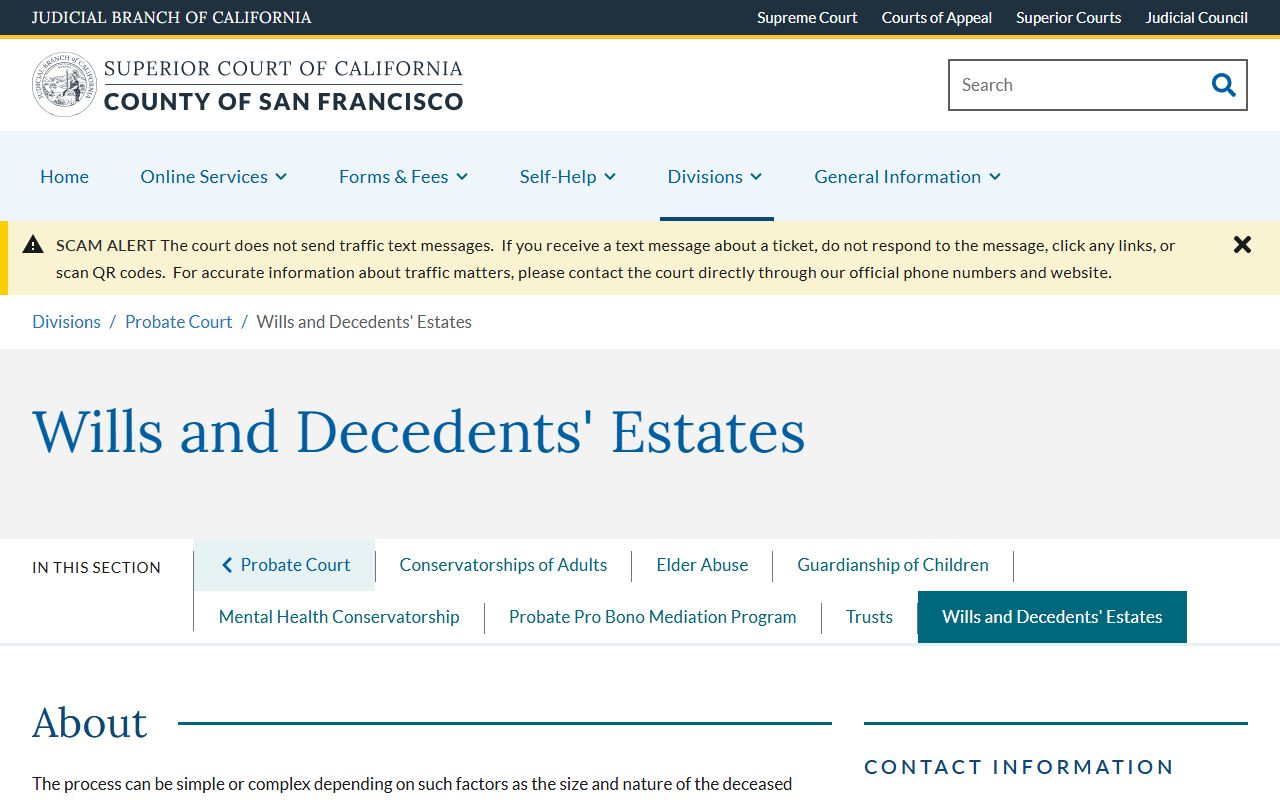
Read this page before opening a San Francisco County probate case to confirm which estate path fits.
Probate Terms Defined
Probate uses words that are not always plain. The list below pulls from the Superior Court's own pages and the California Probate Code. Short, clear definitions make the rest of the page easier to read.
- Testator
- A person who has made a will. After death, the will is offered for probate at the Civic Center Courthouse if the case meets filing rules.
- Executor
- The person named in the will to carry out its terms. The court gives the executor authority through letters testamentary.
- Administrator
- The person the court names to handle an estate when there is no will or no eligible executor.
- Personal Representative
- The broad term that covers both an executor and an administrator. Most San Francisco probate notices use this term.
- Intestate
- Dying without a will. State law decides who inherits, and the court appoints an administrator to manage the file.
- Conservatorship
- A court case in which a judge gives one adult the power to make decisions for another adult who can no longer act for self.
- Guardianship
- A court case that gives an adult the power to care for a minor or to manage a minor's property when a parent cannot.
How to Search San Francisco County Probate Records
The court keeps its probate search behind the same gate as other civil files. Users open the Case Calendar and Query page on the Superior Court site, then pick the civil case query path. The civil tool covers estate, trust, guardianship, conservatorship, and elder abuse files. A captcha runs before the query opens. Civil registers go back to 1987. Imaged probate documents are available for estate and trust files only from 2001 to the current day. Guardianship, conservatorship, and elder abuse images are not online.
- Open the Case Calendar and Query page on sf.courts.ca.gov rather than any private site. The court warns users to avoid third-party tools.
- Choose the civil case query. Probate, trust, guardianship, conservatorship, and elder abuse cases all sit on the civil side of the query.
- Clear the captcha. Every query path needs it before the search box loads.
- Type the case number when you have one. A case number is the fastest path and avoids name-match errors.
- For a name search, use the format from the court's Name Query PDF: lastname; lastname, firstname; or company name. For a decedent or estate, try the decedent's last name first.
- Open the register of actions. For estate and trust cases from 2001 forward, click into the imaged documents. For guardianship, conservatorship, and elder abuse, plan a courthouse trip to view the file.
- If the file appears confidential or sealed, request advance approval through the Probate Department before any in-person viewing.
The search-field table below pulls the fields the court exposes for probate case lookup. The civil query uses one shared form for all civil and probate matters.
| Field | Type | Required | Notes |
|---|---|---|---|
| Civil/probate case number | Text | Optional but preferred | Use the civil case query after the captcha. |
| Case name / estate or trust name | Text | Optional | Format follows the court's name-query PDF. |
| Party / decedent name | Text | Optional | Use lastname or lastname, firstname. |
| Captcha | Verification | Required | Runs before the case query opens. |
San Francisco County Probate Department
The Probate Department sits in Department 204 at the Civic Center Courthouse, 400 McAllister Street. The clerk's office handles probate filings at filing windows 23, 24, and 25. The same windows take petitions for probate, letters, guardianship, conservatorship, and elder abuse. Probate investigators support guardianship and conservatorship work by checking facts about proposed wards and conservatees. Each office answers a different phone line, so the right number speeds up the call.
Probate Department - Department 204
Civic Center Courthouse
400 McAllister Street, Department 204
San Francisco, CA 94102-4514
Investigators: 415-551-3657
Courtroom Clerk: 415-551-3702
Section Clerk Supervisor: 415-551-3673
Filing Windows 23, 24, 25: 415-551-3892
Mon-Fri 8:30 a.m.-4:00 p.m. (closed noon-1 p.m.)
The court is closed on court holidays. The filing windows close for lunch from noon to 1:00 p.m. Plan trips around those gaps. For confidential probate file viewing, non-parties need advance approval from the Probate Department. The records page lists Room 202 at Civic Center Courthouse and a contact line at 415-551-3650 for that approval step.
The Probate Court division has its own landing page with calendar, contact, and process notes. The Probate Court division page ties together estates, trusts, guardianships, conservatorships, and elder abuse work.
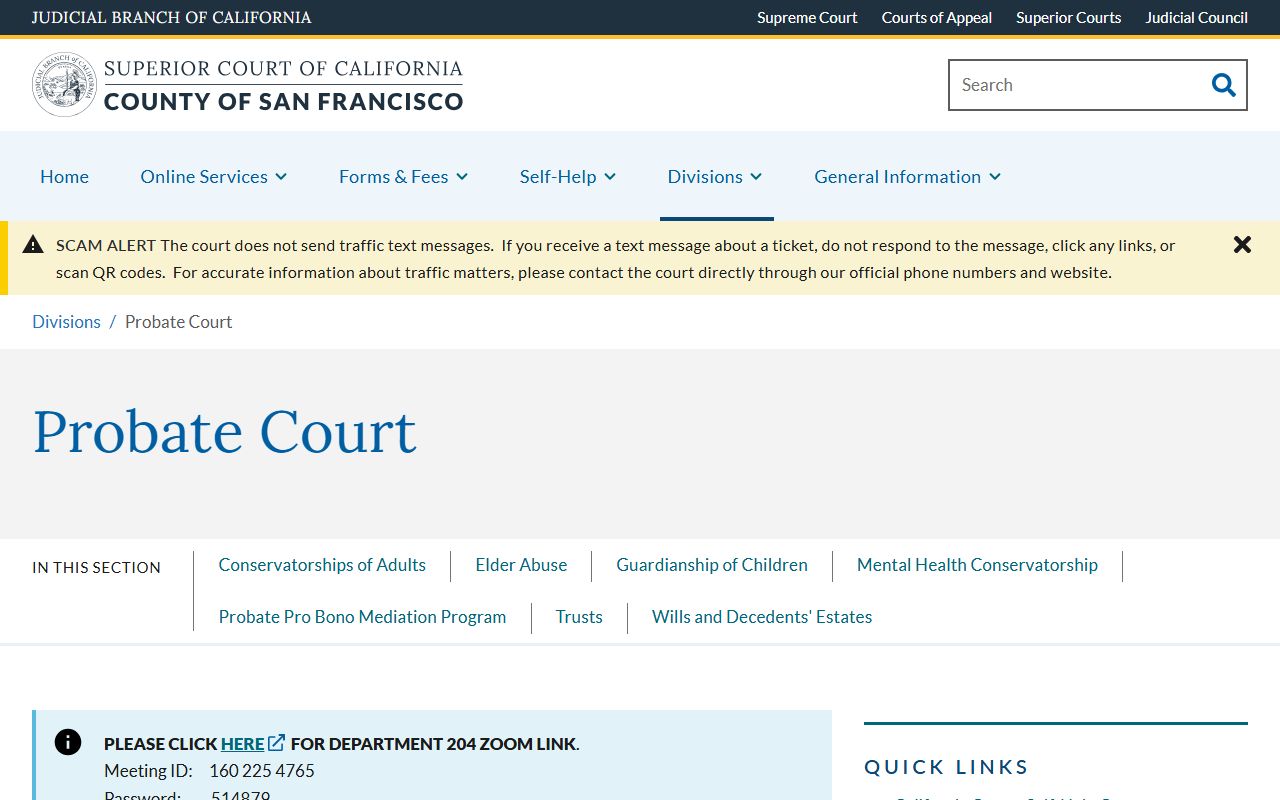
Use this page to navigate between probate calendars before filing any San Francisco County probate paperwork.
Small Estates and the Affidavit Path
Not every estate needs full probate. The Superior Court's probate page says a decedent's personal property may be collected without court administration when the estate is small enough. The thresholds come from Probate Code section 13100 through section 13116. For deaths on or after April 1, 2022, the limit is $184,500. For deaths before April 1, 2022, the limit is $166,250. The court links a sample affidavit for collection of personal property under Probate Code sections 13100 to 13106.
A small-estate affidavit is not the same as a full probate petition. It is a sworn paper the heir or successor gives to the bank, broker, or other holder of the asset. The holder of the asset, not the court, makes the call to release the funds. A full probate filing is still needed when the estate is over the limit, when real property is in play and no other exemption fits, or when the parties cannot agree on who should act.
The state code page sets the official threshold and the affidavit rules. The California Probate Code section 13100 page is the source for the small-estate personal property affidavit.
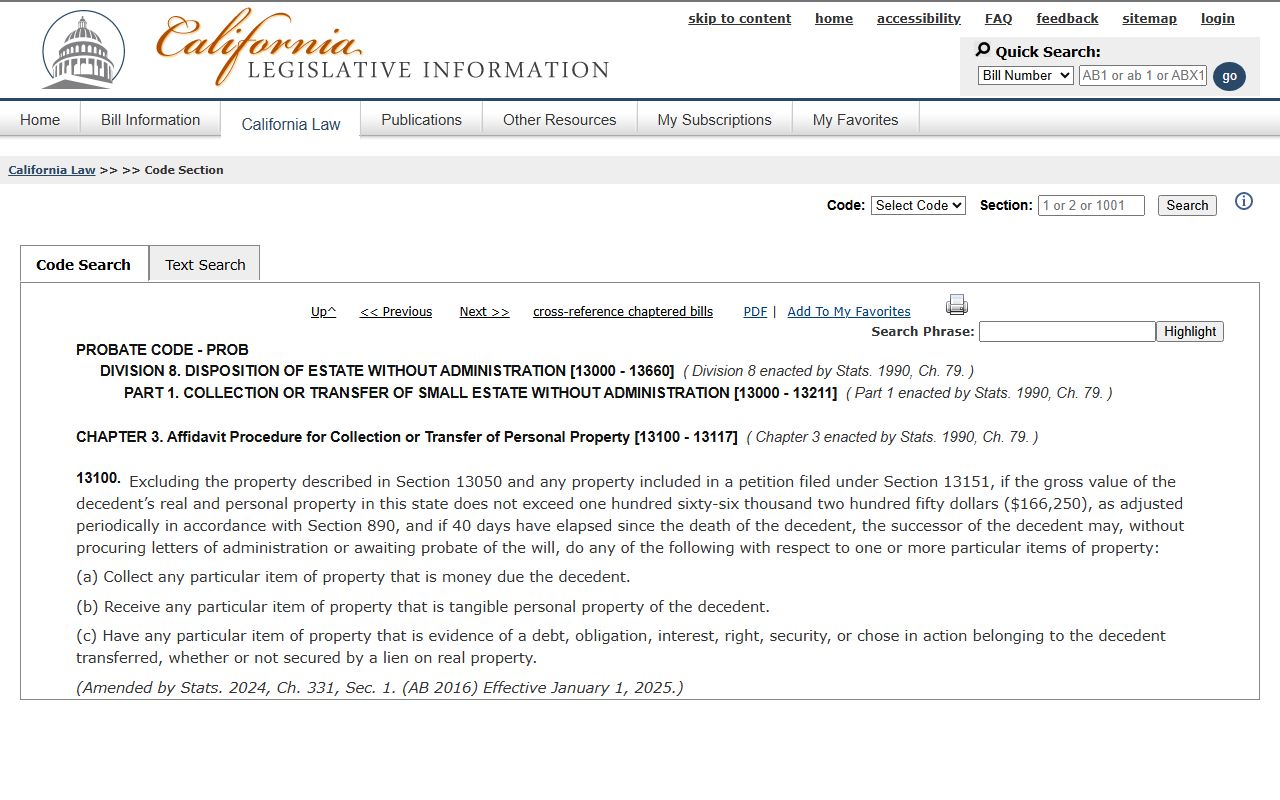
Check the statute text before relying on a small-estate affidavit for a San Francisco County probate matter.
What San Francisco County Probate Records Show
A probate file builds up over the life of the case. Early on, the file holds the petition for probate or letters, the lodged will if one was filed, proof of death, and the order setting a hearing date. As the case moves, the file grows to hold notices to heirs and creditors, the inventory and appraisal, claims, creditor responses, sale of property orders, accountings, and the final order of distribution.
The register of actions is the spine of any probate file. It lists every document filed and every hearing held. For estate and trust matters from 2001 forward, the register links to the imaged document. Guardianship, conservatorship, and elder abuse files have a register online, but the documents themselves are not viewable online. Imaged files open as PDFs, so a current reader is needed and pop-up blockers must be off.
Probate notices and hearings are public unless sealed. The Department 204 calendar sits on the court's case calendar page. To check what is in a specific file, use the case number from the register, then go through the civil case query path.
Probate Filing Fees
Filing fees in California are largely set by state law. The Superior Court collects them at the Civic Center Courthouse filing windows. The table below covers common probate court items. Court copy and certification rates also follow the Civil Records Request Form. Verify the exact current rate before sending a check, since the Judicial Council updates statewide fees from time to time.
| Item | Fee |
|---|---|
| Civil plain copies (probate filings) | $0.50 per page |
| Civil certification fee | Listed on Civil Records Request Form; verify current rate |
| Exemplified copy processing time | 12-15 court days |
| Confidential file viewing approval | Request through Probate Department, Room 202 |
| Recorder document self-service copy | $1.81 per document |
| Small-estate affidavit threshold (death on/after April 1, 2022) | Up to $184,500 in personal property |
| Small-estate affidavit threshold (death before April 1, 2022) | Up to $166,250 in personal property |
How Probate Works in San Francisco County
The court breaks the process into clear steps on its Wills and Decedents' Estates page. The list below tracks those steps for a typical decedent's estate. Trust, guardianship, and conservatorship matters follow a similar arc with different forms and notice rules.
- Decide whether full probate is needed or whether a small-estate affidavit under Probate Code section 13100 will work.
- Lodge the original will with the court if one exists, then prepare the petition for probate and letters.
- File at the Civic Center Courthouse probate filing windows 23, 24, or 25 and pay the filing fee.
- Give the required notice to heirs, beneficiaries, creditors, and other interested parties.
- Attend the hearing in Department 204 if the court asks for one. Many uncontested matters move on the tentative ruling track.
- Once appointed, the personal representative gathers assets, notifies creditors, prepares an inventory and appraisal, and pays approved debts, taxes, and expenses.
- Close the case by filing an account or report and a petition for final distribution, unless law allows a waiver or a simpler closing path.
Steps may stall when an heir cannot be found, when a creditor files a late claim, or when the parties cannot agree on distribution. Self-represented filers can use the court's self-help center and online forms.
Confidential and Restricted Probate Records
Some probate items are not open to the public, even in person. The Superior Court records page says only parties may view certain probate files. Non-parties need advance approval from the Probate Department, Room 202, at the Civic Center Courthouse, with contact at 415-551-3650. Guardianship and conservatorship cases often hold sensitive medical, financial, and family content. Mental health conservatorship matters and CARE Act items add another layer of privacy.
Sealed files follow California Rules of Court rule 2.550. The sealing procedure sits at rule 2.551. A member of the public who wants to unseal a probate item must file a motion that sets out a basis to lift the seal. Adoption files are confidential under Family Code section 9200. Juvenile probate matters can fall under Welfare and Institutions Code section 827 when a minor is involved.
Note: Non-parties seeking confidential probate documents must first call 415-551-3650 for advance approval and may need to identify the case number and the document sought.