
How to Search San Francisco County Traffic Court Records
Traffic case lookups in San Francisco County start at the Superior Court's Online Services page. The court links its official traffic payment and case search tools from that landing page. The court warns the public not to start from a third-party traffic site. The court also warns that it does not send text messages about tickets. Any text about a San Francisco citation is a known scam.
Before you start, pull the citation out and check the basics. You will want the citation number, the issuing agency, the violation date, and the cited code section. A driver license number works when the citation is lost. Name-only lookups are limited and the court often routes name searches to a phone call with the Traffic Division.
- Open the Superior Court Online Services page and pick the traffic case search or payment link the court lists there.
- Enter the citation number. If you do not have it, enter the driver license number. Citation number is the most reliable path.
- Pass the captcha gate. The court uses the same captcha screen on civil, criminal, and traffic queries.
- Confirm the charge, the court date, and whether the citation is marked mandatory appearance. Do not pay a mandatory case online; appear instead.
- Pick a path. Pay the bail, request a court trial, file a trial by written declaration, ask for traffic violator school, or request a continuance.
For older citations or holds, call the Traffic Division at 415-551-8550 before you pay anything. The phone line runs 4:00 a.m. to 9:00 p.m. on weekdays. That window is wider than the in-person service window at Room 145, which is 8:30 a.m. to 4:00 p.m. with a noon to 1:00 p.m. lunch closure.
The court groups every official portal on one menu. The Online Services landing page links to traffic search, payment, civil, criminal, and self-help tools.
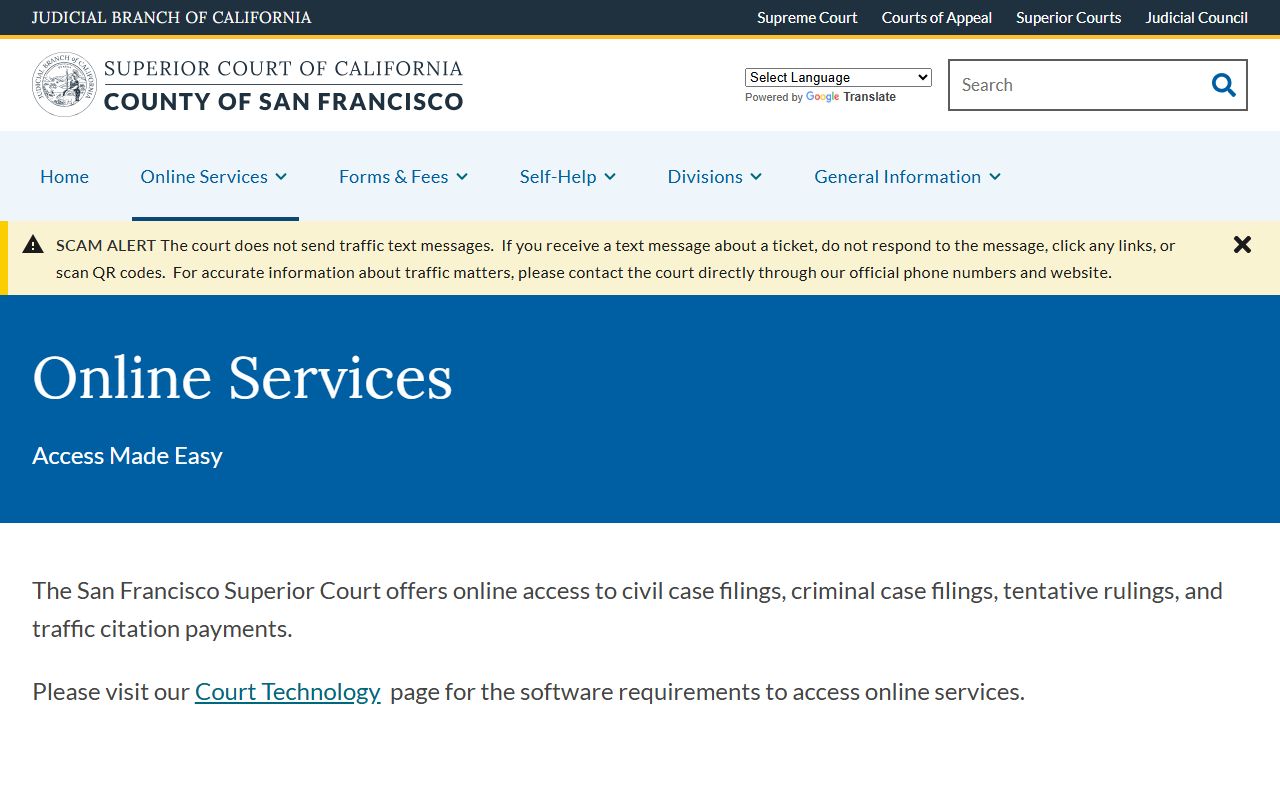
Begin every San Francisco County traffic court records lookup at this page rather than a third-party site.
Which Courts Handle Traffic Cases in San Francisco County
San Francisco runs a unified Superior Court. There are no separate justice of the peace, municipal, or city traffic courts at the local level. Traffic infractions, traffic misdemeanors, and code violations all sit with the Superior Court of California, County of San Francisco. The Traffic Division is the part of the court that hears these cases.
The Traffic Division does not handle parking. Parking citations go to the SFMTA as a city administrative matter. The DMV handles driver license points, suspensions, and the abstract of driving record. That split matters when people search for a "traffic record" in San Francisco. A court traffic case, a SFMTA parking case, and a DMV driver record are three different files held by three different offices.
| Agency | Traffic Cases Handled | Address / Contact |
|---|---|---|
| Superior Court Traffic Division | Vehicle Code infractions, traffic misdemeanors, county ordinances, photo enforcement | Hall of Justice, 850 Bryant Street, Room 145, San Francisco, CA 94103; 415-551-8550 |
| Superior Court Criminal Division | DUI, misdemeanor reckless, and other criminal traffic charges | Hall of Justice, 850 Bryant Street, Room 101; 415-551-0651 |
| SFMTA | Parking citations (not court matters) | sfmta.com |
| California DMV | Driver record, points, license status, abstract of driving record | dmv.ca.gov |
Note: Juvenile traffic matters are heard at the Juvenile Justice Center, 375 Woodside Avenue, not at the Hall of Justice.
The criminal courthouse hosts most traffic services for the adult side. The Hall of Justice page covers Room 145 traffic and Room 101 criminal records.
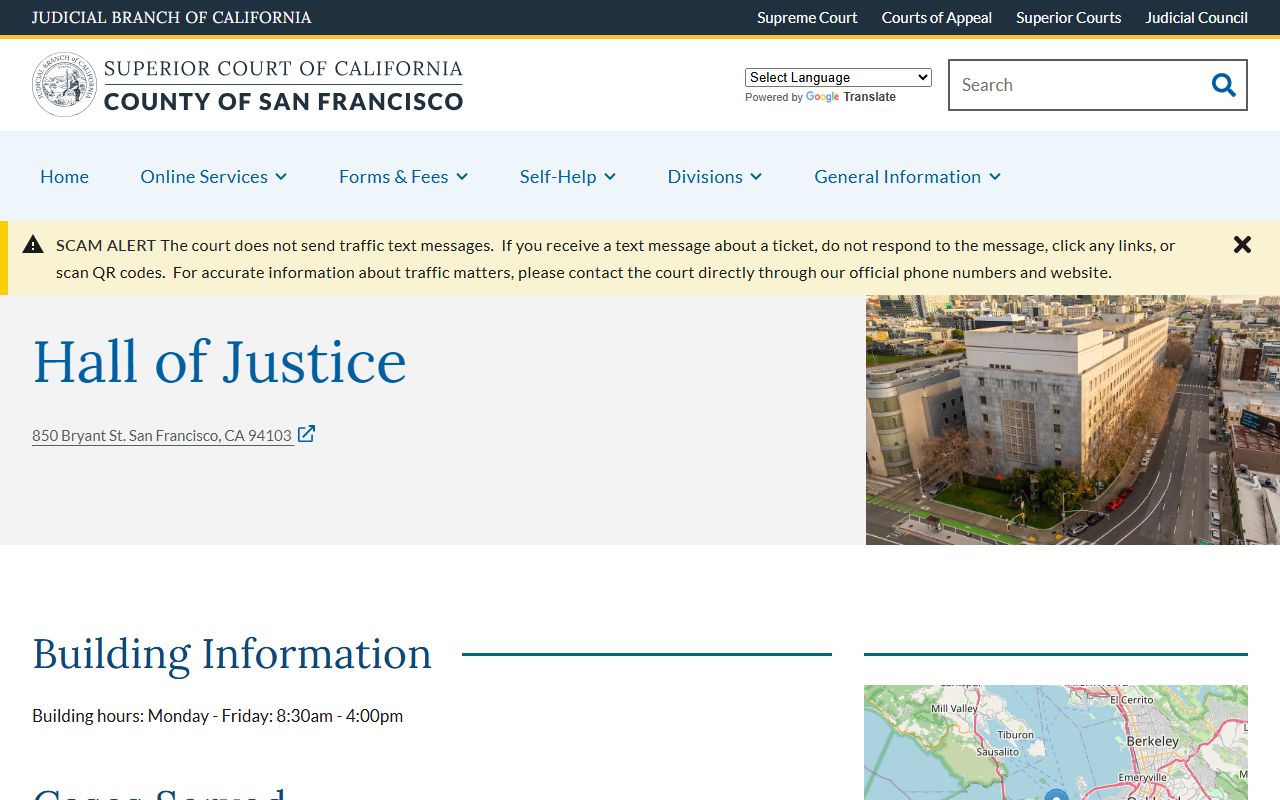
Use this page to confirm the right room and entry point before visiting Hall of Justice for a San Francisco County traffic court records matter.
Types of Traffic Cases on Record
The Superior Court Traffic Division hears a wide mix of cases. Most are Vehicle Code infractions issued by SFPD, CHP, BART Police, or other peace officers in the county. Some are San Francisco Municipal Code or county ordinance violations. A small share are misdemeanors that route through Traffic Division calendars before any move to the Criminal Division.
- Moving violations. Speed, stop sign, red light, lane change, and other Vehicle Code infractions cited at the scene.
- Non-moving violations. Equipment, registration, and insurance citations that do not involve driver conduct in motion.
- Photo enforcement. Red light camera and speed safety pilot citations served by mail. These are court cases once filed, not SFMTA parking matters.
- Commercial vehicle and CDL cases. Same Vehicle Code charges but with stricter federal and state rules tied to the CDL record.
- Traffic misdemeanors. Reckless driving and other charges that go beyond infraction status. DUI under Vehicle Code 23152 routes to the Criminal Division.
Parking citations sit at the SFMTA and are not part of the court traffic file. A driver who searches the court system for a parking ticket will get no result, because that ticket is a city administrative case.
What San Francisco County Traffic Court Records Show
A San Francisco County traffic court record collects the case data from filing through final order. The register of actions lists each event. Imaged traffic documents are not broadly available online. The case calendar shows hearing dates but not full document images. The fields below come from the Traffic Division case structure.
| Field | What It Shows |
|---|---|
| Citation Number | Unique number assigned by the issuing officer or agency. |
| Issuing Agency | SFPD, CHP, BART PD, Park Rangers, MUNI fare inspectors for fare and code matters, or another peace officer agency. |
| Violation Date | Date and time of the alleged violation. |
| Violation Location | Street, intersection, or freeway location where the citation was issued. |
| Code Section | California Vehicle Code section, San Francisco Municipal Code section, or other charged statute. |
| Charge Description | Plain language description of the violation. |
| Court Date | Date the citation is set for court, marked mandatory or optional. |
| Department | Court department hearing the matter. |
| Bail / Total Due | Bail on the citation plus state-mandated assessments, fees, and surcharges. |
| Disposition | Plea, finding, or outcome such as paid, traffic school, dismissed, or guilty after trial. |
| Sentence / Order | Fine amount, traffic school order, probation, community service, or jail for misdemeanors. |
| Failure to Appear / Failure to Pay | Flag set when a civil assessment or warrant has issued. |
| Comprehensive Collections | Flag set when the case is in collections for unpaid amounts. |
Sealed traffic records are pulled from public online access. Imaged copies of misdemeanor traffic files go through the Criminal Records Department at Hall of Justice Room 101. Infraction copies tied to civil records may come from the Civil Records Department at the Civic Center Courthouse depending on case category.
Searching by Citation Number vs by Name
Citation number is the best path for a San Francisco County traffic lookup. The number ties the search to one case, not many. Name-only searches in traffic are limited. The court often points name searches to a phone call with the Traffic Division. The table below lists the actual search fields used on the Superior Court traffic portal.
| Field Label | Type | Required | Notes / Format |
|---|---|---|---|
| Citation Number | text | yes for citation lookup | Format varies by issuing agency; printed on the ticket. |
| Driver License Number | text | alternative | Use when the citation number is unavailable. |
| Date of Citation | date | optional | Narrows the search if multiple cases exist. |
| Last Name / First Name | text | name search only | Court directs some name searches to Traffic Division phone. |
| Department | dropdown | optional | Used for calendar and court date searches. |
| Captcha | verification | yes | Same captcha gate used on civil and criminal queries. |
| Submit | button | yes | Sends the query to the court traffic backend. |
The court appearance calendar tool covers up to 120 days. That tool can show a future court date when a citation has been set but the user does not yet know which department will hear it.
Paying or Contesting a San Francisco County Traffic Ticket
San Francisco gives drivers a few paths after a citation. The right choice depends on whether the case is mandatory appearance, whether the driver wants to keep the violation off the DMV record, and whether a trial fits the facts. Paying the bail closes the case as a conviction unless traffic school applies. A trial by written declaration under Vehicle Code 40902 lets the driver fight the ticket on paper, with bail posted first.
The steps below walk through both paths. Drivers should not respond to any text claiming to be from the court. The Superior Court does not send ticket text messages. Real court contact starts from sf.courts.ca.gov or the Traffic Division phone line.
- Read the citation. Note the citation number, the cited code section, the court date, and whether appearance is mandatory.
- Pick a path. Pay bail, request a court trial, file a trial by written declaration, ask for traffic school if eligible, or hire a traffic attorney.
- To pay online, open the court's traffic payment portal from the Online Services page. Have a credit or debit card and the citation number ready.
- To request a court trial by written declaration, file form TR-205 with bail before the appearance date.
- To ask for traffic school, file form TR-105 or use the online traffic school option where the court offers it. Pay bail plus the traffic school administrative fee.
- To appear in court, go to Hall of Justice Room 145 on the assigned date and time, or attend the assigned department.
- After conviction, finish the traffic school course in the time set, file the completion certificate, and confirm case status with the Traffic Division.
The Traffic Division phone line at 415-551-8550 runs from 4:00 a.m. to 9:00 p.m. on weekdays. That is far wider than the in-person service window. Call hours often work well for drivers who cannot get to Room 145 during the 8:30 a.m. to 4:00 p.m. service block.
Public Access Laws for Traffic Court Records
Traffic court records sit inside the same California public access framework that covers other Superior Court files. Most traffic infraction events show up in the register of actions. The case calendar tool lists future hearings. Imaged traffic documents are not broadly online. Sealed traffic records are excluded from online access. Driver record release by the DMV is a separate track and follows Vehicle Code section 1808.
Key Statutes:
California Rules of Court rules 2.500 to 2.507 set the access framework for trial court records, including remote electronic access limits on certain categories.
California Rules of Court rule 2.550 defines sealed records and sets the standard for when a court file may be sealed.
California Vehicle Code section 1808 governs DMV release of driver records and is the main reason a court file and a driver record are not the same record.
Government Code section 68150 supports the court's electronic records management, which is part of why some case categories show register-of-actions data online.
The court's judicial administrative records request form is for California Rules of Court rule 10.500 administrative records, not for case files. Traffic case copies go through Criminal Records or Civil Records depending on whether the case is a misdemeanor or an infraction.
Court Traffic Records vs State Driver Records
The most common San Francisco traffic mix-up is the court file versus the DMV driver record. They are not the same. The court file is the case. The driver record is the long term DMV history of license status, points, and abstract data. A court can dismiss a case while the DMV still shows a related record entry. A driver who needs both must request both, from two different agencies.
| Item | Court Traffic Record (Superior Court) | State Driver Record (DMV) |
|---|---|---|
| Record source | Superior Court of California, County of San Francisco | California Department of Motor Vehicles |
| What it contains | Citation, charge code, disposition, fines, FTA/FTP notations, court orders | License status, points, abstract of driving record, suspensions, FRR holds |
| Where to access | Hall of Justice Room 145; Online Services traffic portal; 415-551-8550 | DMV online portal, DMV office, or DMV record request |
| How to correct an error | Court motion or call the Traffic Division | DMV record correction process |
| Public access | Court rules and trial court records statutes | Vehicle Code 1808; access limited to authorized requesters |
| Use in employment screening | Limited by court rules; some dispositions may be sealed | Used widely; some employers require a Pull Notice or DMV record |
Note: Court dispositions flow to the DMV through state reporting, but the driver record itself is built and held by the DMV, not the court.
CDL and Commercial Driver Records
San Francisco County CDL holders face stricter rules than regular drivers. The state framework sits at California Vehicle Code section 15300 and following, with federal rules at 49 C.F.R. § 383. A CDL holder generally cannot use traffic school to keep a moving violation confidential. Some violations that a Class C driver could reduce stay on the CDL record.
Court case flow is the same. CDL cases run through the ordinary Traffic Division calendar at Hall of Justice. The difference shows up at the DMV level, where the CDL conviction rules apply once the court reports the disposition. A CDL holder should talk to a traffic attorney before any plea. Preserving the chance of trial matters more on a CDL than on a Class C license.
DUI Cases
DUI in California is charged under Vehicle Code section 23152, and Vehicle Code section 23153 when injury is involved. DUI is the standard state term; DWI is used in some other states for the same kind of charge. DUI cases in San Francisco are criminal, not infractions. They are heard through the Criminal Division at the Hall of Justice, not Room 145. DUI files are requested through the Criminal Records Department at Hall of Justice Room 101.
For full San Francisco County DUI case information, see San Francisco County criminal records. A DUI also triggers a DMV administrative action and a license suspension that runs on its own track, separate from the criminal case.
The Criminal Division page explains how DUI and other criminal traffic charges move through the system. The Criminal Division page covers arraignment, bail, and case-flow steps for criminal traffic matters.
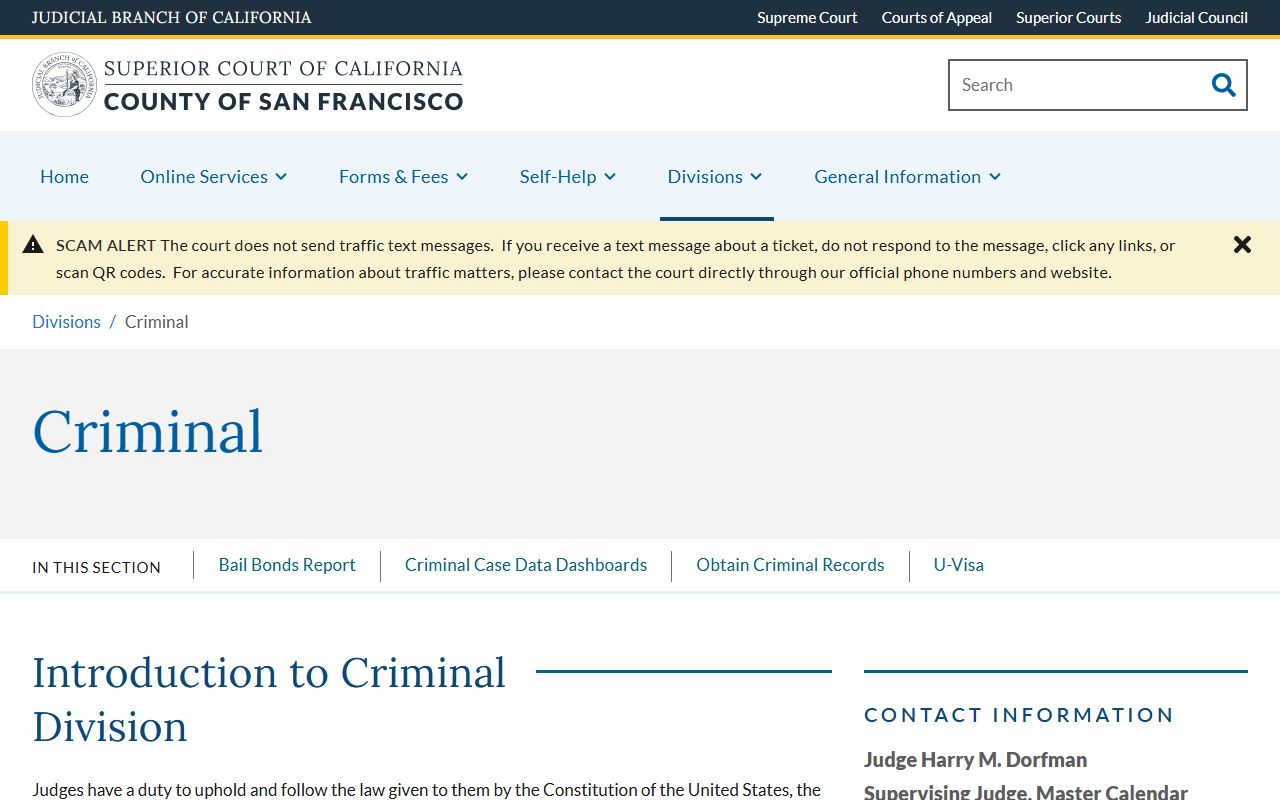
A San Francisco DUI case lives on the criminal track, so this page is the right starting point for any DUI records pull.
Deferred Adjudication and Traffic Violator School
California does not use "deferred adjudication" the way Texas does for traffic cases. The closest tool here is traffic violator school. Under California Vehicle Code section 41501 and the Judicial Council's traffic school rules, an eligible driver may pay the bail, pay a traffic school administrative fee, and finish a state-licensed traffic violator school course to keep the violation confidential on the DMV driving record.
Eligibility is tight. The driver may use traffic school once every 18 months. Only eligible Vehicle Code infractions in a noncommercial vehicle qualify. Some equipment violations are not eligible, and CDL holders cannot use traffic school to mask a moving violation. The court still enters the conviction, but reports it as confidential to the DMV, so no points are added. The Traffic Division phone line and the Online Services page are the right places to confirm a specific citation's eligibility.
Sealing or Expunging Traffic Records
Traffic infractions are usually not eligible for Penal Code 1203.4 dismissal. That statute covers misdemeanor and some felony convictions, not pure infractions. For an infraction, the main path to keep the conviction off the driver record is traffic school. A motion to vacate may apply in some cases. Category specific relief may be available when an infraction was reduced from a misdemeanor.
A traffic misdemeanor may be eligible for Penal Code 1203.4 relief once probation is complete. Misdemeanor reckless under Vehicle Code 23103 or a first time DUI under Vehicle Code 23152 may qualify. Penal Code 851.91 covers sealing arrests that did not result in conviction. A driver with old traffic misdemeanors or a DUI on record should call the Public Defender Clean Slate Program at 415-553-9337 or talk to an attorney. The Clerk of the Superior Court can also point a self represented driver to the right form.
Fees for Traffic Record Copies
Traffic fees in San Francisco County come in two layers. The first is the bail or fine on the citation itself, which varies by code section and assessments. The second is the copy and request fee charged by the court when someone asks for a paper file. Civil records copies are 50 cents per page plain copy, with a certification fee per the court schedule. Misdemeanor traffic copies go through the Criminal Records Department and use the Criminal Records Request Form.
| Item | Amount / Source |
|---|---|
| Traffic case bail or fine (per citation) | Varies by code section and assessments; posted on the citation. |
| Failure to appear / failure to pay civil assessment | $100 (Penal Code 1214.1; Vehicle Code 40508) |
| Traffic school administrative fee | Set by the court schedule (Vehicle Code 42007) |
| Court trial by written declaration | Bail amount as posted (Vehicle Code 40902) |
| Criminal records request copies (DUI / misdemeanor traffic) | Per the court fee schedule; Hall of Justice Room 101. |
| Civil records plain copy | $0.50 per page; certification fee per court schedule. |
A driver who missed a court date or a payment date should expect the $100 civil assessment on top of the original amount. The Superior Court collects unpaid traffic balances through the Comprehensive Collections Unit at the Hall of Justice. The court can also place a DMV hold on driver license renewal. Statewide amnesty programs sometimes open a discount window; San Francisco joins those programs when the Judicial Council or Legislature sets them up.