
San Francisco Superior Court Overview
The Superior Court of California, County of San Francisco is the unified trial court for the city and county. It hears civil, criminal, family, probate, juvenile, traffic, small claims, and mental health matters. The court also runs several specialty calendars, from Drug Court to Veterans Court to Behavioral Health Court. There is no separate city court, no JP court, and no municipal court. The court's home page lists Presiding Judge Rochelle C. East and Court Executive Officer Brandon E. Riley as the current court leaders.
Before 1998, California ran two trial-court layers in each county. Superior courts heard the bigger cases. Municipal courts heard the smaller ones. Proposition 220 let counties merge those layers. San Francisco took that step. The result is one court, one filing system, and one set of public records, split across four facilities. The court is one of 58 superior courts statewide. Appeals head to the California Court of Appeal, First Appellate District, which also sits in San Francisco.
Why "District Court" in San Francisco Means Federal Court
The word "district court" carries a different meaning in California than in many other states. There is no California state district court. The federal trial court for the region is the U.S. District Court for the Northern District of California. That court sits in the Phillip Burton Federal Building and U.S. Courthouse, 450 Golden Gate Avenue, San Francisco, CA 94102. Federal civil suits, federal crimes, civil rights cases, and federal-question matters get filed there. Federal records sit in PACER, not in the state court portal.
People who arrive at a "district court" search expecting a local trial court of that name will not find one. State trial court records live with the Superior Court. Federal cases live in PACER and CM/ECF. Bankruptcy files are with the U.S. Bankruptcy Court for the Northern District of California. Federal appeals run to the Ninth Circuit.
The federal trial court has its own home page that links to PACER, opinions, and the courthouse. The U.S. District Court for the Northern District of California home page is the right starting point for federal cases out of San Francisco.
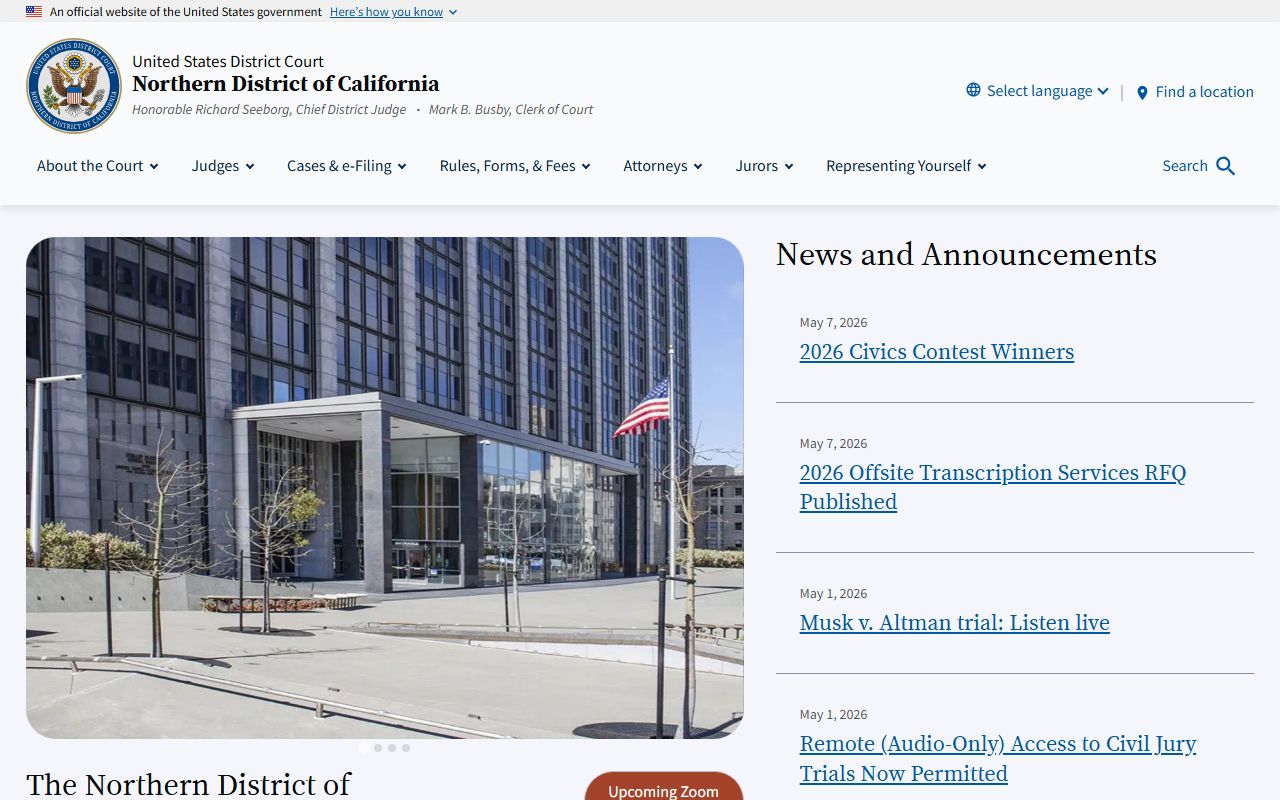
For a San Francisco federal record, this is the safest starting point before paying for PACER access.
The Four San Francisco Superior Court Facilities
The court runs out of four buildings rather than a single county courthouse. The Civic Center Courthouse is the main civil, family, probate, traffic, and self-help building. The Hall of Justice is the criminal courthouse. The Juvenile Justice Center hears juvenile delinquency and dependency. The Polk Street Annex hosts the Community Justice Center and specialty calendars. Filing windows, record rooms, and courtroom phones differ by site.
| Facility | Address | Phone | Primary work |
|---|---|---|---|
| Civic Center Courthouse | 400 McAllister Street, San Francisco, CA 94102 | 415-551-4000 | Civil, family, probate, traffic, ACCESS Center, jury services. |
| Hall of Justice | 850 Bryant Street, San Francisco, CA 94103 | Criminal 415-551-0651; Traffic 415-551-8540 | Criminal and traffic; criminal records; collections; interpreters. |
| Juvenile Justice Center | 375 Woodside Avenue, San Francisco, CA 94127 | 415-682-5202 to 415-682-5204 | Juvenile delinquency, dependency, juvenile traffic. |
| Polk Street Annex / Community Justice Center | 575 Polk Street, San Francisco, CA 94102/94103 area | Department 8 at 415-551-3837 | Community Justice Center, Drug Court, Veterans Court. |
The Civic Center Courthouse opened in 1998 after Loma Prieta earthquake damage forced the court out of City Hall. Civil Division work runs from Room 103. Unified Family Court is on the 4th floor. The Hall of Justice hosts criminal record windows 7 and 8 in Room 101 and traffic services in Room 145.
The main building has its own page with hours, departments, and parking notes. The Civic Center Courthouse page covers Room 103, Room 509, jury services, and self-help.
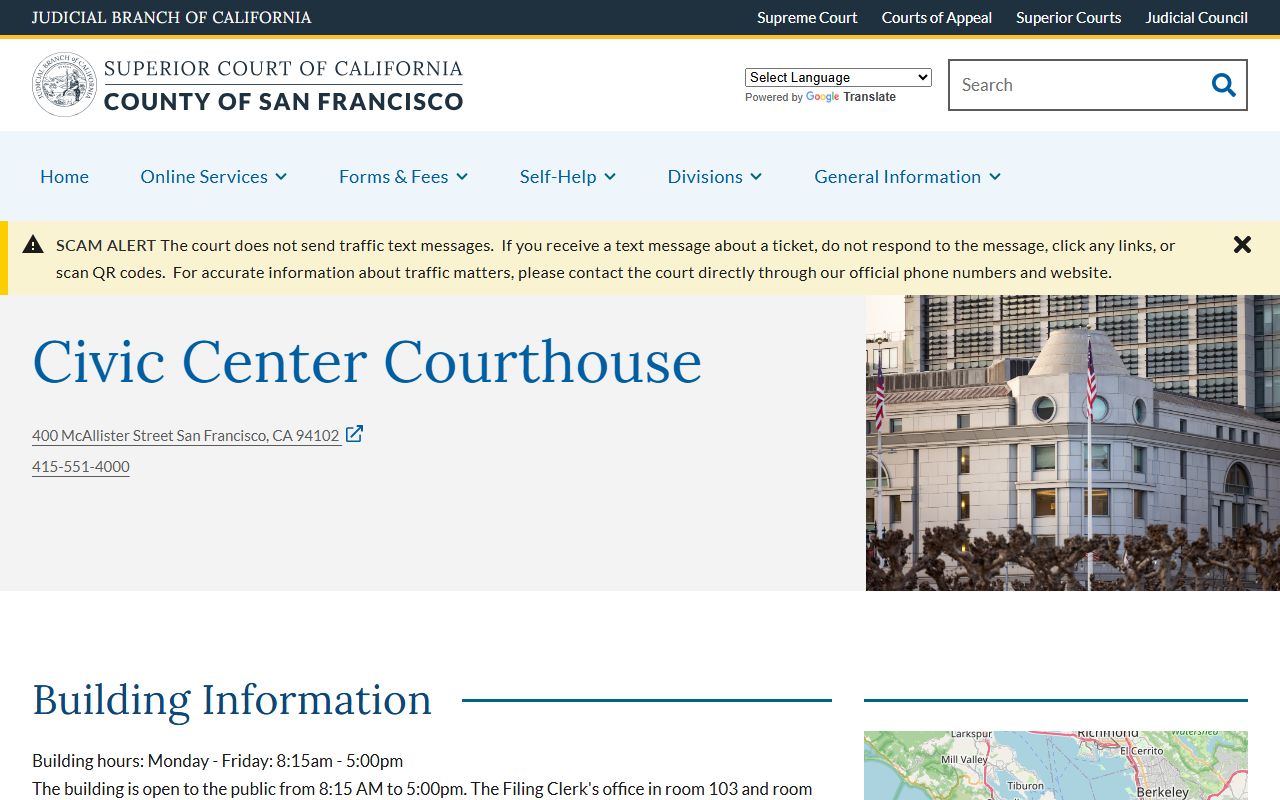
Check this page before walking in for a civil, family, probate, traffic, or self-help San Francisco County court records visit.
The criminal courthouse has a separate page with its own hours and services. The Hall of Justice page covers Room 101 criminal records and Room 145 traffic.
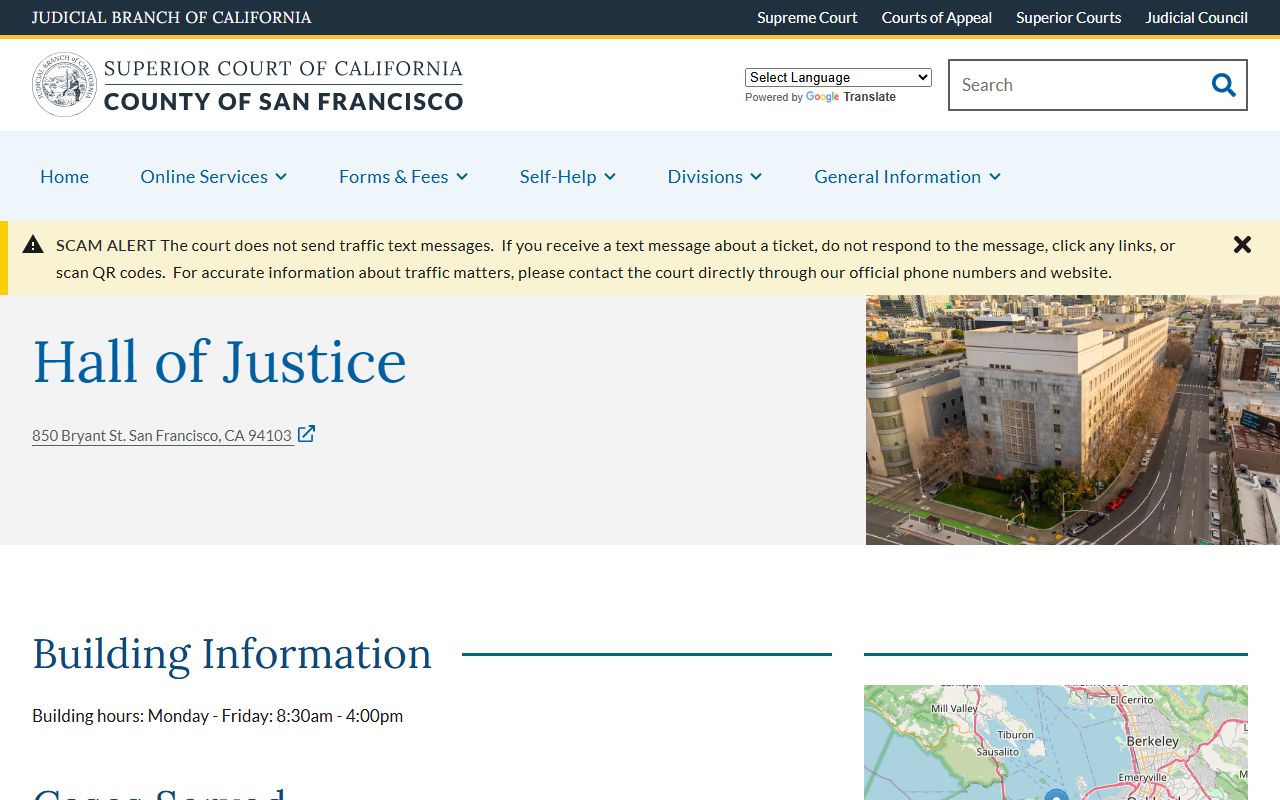
Plan a Hall of Justice trip with this page open, since criminal records and traffic services do not run out of the Civic Center building.
San Francisco Superior Court Departments
The court's 2026 judicial assignments list department numbers, the type of work each one handles, the facility it sits in, and the courtroom phone. Criminal departments cluster at the Hall of Justice. Probate sits at Civic Center. Specialty courts run from Polk Street. The full table below includes the criminal master calendar, preliminary hearing rooms, the mental health calendar, the misdemeanor calendar, probate, and the specialty hub at Department 8.
| Court / Dept | Type | Address | Phone |
|---|---|---|---|
| Department 8 | CJC / Drug Court / Veterans Court | 575 Polk Street | 415-551-3837 |
| Department 9 | Preliminary hearings / arraignments | 850 Bryant, 1st floor | 415-551-0309 |
| Department 10 | Trials / motions to suppress / 995 motions | 850 Bryant, 1st floor | 415-551-0310 |
| Department 11 | Preliminary hearings / arraignments | 850 Bryant, 1st floor | 415-551-0311 |
| Department 12 | Preliminary hearings / arraignments | 850 Bryant, 1st floor | 415-551-0312 |
| Department 13 | Trials / Pitchess-Brady / expungements | 850 Bryant, 2nd floor | 415-551-0313 |
| Department 14 | Domestic violence a.m.; felony arraignments p.m. | 850 Bryant, 2nd floor | 415-551-0314 |
| Department 15 | Mental Health Court / Behavioral Health Court / Mental Health Diversion | 850 Bryant, 2nd floor | 415-551-0315 |
| Department 16 | Trials | 850 Bryant, 2nd floor | 415-551-0316 |
| Department 17 | Misdemeanor master calendar / arraignments | 850 Bryant, 2nd floor | 415-551-0317 |
| Department 22 | Criminal Master Calendar / supervising criminal judge | 850 Bryant, 3rd floor | 415-551-0322 |
| Department 26 | Trials / Young Adult Court | 850 Bryant, 3rd floor | 415-551-0326 |
| Department 204 | Probate, Wills and Decedents' Estates | 400 McAllister Street | Courtroom clerk 415-551-3702 |
Probate has its own contacts. Department investigators answer at 415-551-3657. The Court Supervisor of the Probate Section Clerk's Office is at 415-551-3673. Windows 23, 24, and 25 in Room 103 share 415-551-3892. The Probate Division landing page is at sf.courts.ca.gov/divisions/probate-court.
Superior Court vs. Federal District Court vs. Court of Appeal
Three court types touch San Francisco cases. The state Superior Court is the local trial court. The federal District Court hears federal claims and federal crimes. The Court of Appeal reviews trial-court rulings. People mix them up because the labels sound alike, but the rules, fees, and records portals are not the same.
| Superior Court | Federal District Court | Court of Appeal | |
|---|---|---|---|
| What it hears | Civil, criminal, family, probate, juvenile, traffic, small claims, specialty cases | Federal crimes, federal-question civil cases, diversity cases, civil rights, federal agency suits | Appeals from Superior Court rulings |
| Location | Four facilities in San Francisco | Phillip Burton FB and U.S. Courthouse, 450 Golden Gate Ave | First Appellate District, San Francisco |
| Records portal | sf.courts.ca.gov case query | PACER and CM/ECF | First District opinions and dockets |
| Trial or review | Trial | Trial | Review only |
| Next step | Court of Appeal, First District | Ninth Circuit | California Supreme Court (by petition) |
That last row matters for record searches. A case that began in Superior Court can show up later in First District records. A federal case has its own appellate trail to the Ninth Circuit.
How a Case Moves Through the System
Cases follow a path that depends on the case type. Criminal cases start with an arrest. Civil cases start with a petition or complaint. Both paths can end with an appeal to the First Appellate District. The diagrams below cover the general flow.
Criminal flow: Arrest › Booking and Intake › Arraignment (Department 14 or 17) › Preliminary hearing or grand jury (Departments 9, 11, 12) › Master calendar (Department 22) › Trial (Departments 10, 13, 16, 26) › Sentencing › Appeal to First District
Civil flow: Petition or complaint filed in Room 103 › Service on parties › Answer or response › Case management › Discovery › Mediation or settlement conference › Trial › Judgment › Appeal to First District
Probate flow: Petition filed at Room 103 windows 23-25 › Notice to heirs and creditors › Hearing in Department 204 › Letters issued › Inventory and appraisal › Final account and distribution › Discharge
A specialty-court case can branch off the criminal flow. A defendant with charges linked to substance use, mental health needs, veteran status, or transition-age status may be referred to Department 8, 15, or 26 for a problem-solving calendar. The work still appears in the criminal record.
Civil, Family, Probate, and Criminal Divisions
The court splits its work into divisions. The Civil Division at the Civic Center Courthouse runs out of Room 103. It handles civil filings, small claims, unlawful detainer, name changes, defaults, and civil restraining orders. The Civil Records page says non-confidential files can be viewed in Room 103 by ID deposit. Windows 23, 24, and 25 in the same room serve probate.
Unified Family Court runs on the 4th floor. It handles divorce, legal separation, custody, child support, parentage, domestic violence restraining orders, juvenile dependency, and adoption. Family Law register-of-actions data can be viewed online with a case number. Family imaged documents are not available online.
The Criminal Division at the Hall of Justice handles felonies, misdemeanors, and infractions other than traffic. The Criminal Division page covers arraignment, bail, jail information, criminal records, and record-cleaning resources. Criminal documents are not online; requests go to Room 101 or by mail. Probate, including Department 204, runs as its own division.
Specialty Courts in San Francisco
Specialty calendars are a notable feature of San Francisco Superior Court. Each one is a problem-solving track that runs alongside the regular criminal or family calendars. Treatment, status reviews, incentives, sanctions, and graduation steps replace a purely punitive path. Eligibility is set case by case by the court, the prosecution, the defense, and the program team.
- Behavioral Health Court, Mental Health Court, and Mental Health Diversion run from Department 15 at the Hall of Justice, with Judge Charles Crompton listed on the 2026 assignments.
- Community Justice Center and Drug Court run from Department 8 at 575 Polk Street, with Judge Murlene J. Randle assigned on the 2026 list.
- Veterans Justice Court also runs from Department 8 and serves veterans with criminal cases in San Francisco, even non-residents.
- Young Adult Court runs from Department 26 at the Hall of Justice and serves transition-age defendants with developmentally informed supervision.
- Family Treatment Court appears under the court's collaborative-courts menu and serves families affected by substance use and child welfare issues.
Because treatment records can contain medical and mental health data, public access to program documents is often more limited than ordinary criminal docket entries.
Appeals From San Francisco Superior Court
An appeal from a Superior Court ruling goes to the California Court of Appeal, First Appellate District. The First District sits in San Francisco and reviews appealable orders and judgments from the trial court. A few statutory tracks, like death-penalty appeals, run directly to the California Supreme Court. The Supreme Court takes a smaller set of cases for discretionary review to resolve important legal questions or splits among the Courts of Appeal.
Trial-court appeal records include the notice of appeal, the designation of record, the remittitur, and the final judgment. The Superior Court keeps a copy. The working appellate file lives with the First District. Federal appeals follow a separate path to the Ninth Circuit.
Court Leadership and Local Rules
The court's home page lists Presiding Judge Rochelle C. East and Court Executive Officer Brandon E. Riley as the current court leaders for 2026. The presiding judge sets calendars and assigns judicial officers. The court executive officer runs operations, including the clerk's office and the court's online systems. Department assignments are posted on the 2026 judicial assignments page.
San Francisco Superior Court also keeps a set of local rules on top of statewide rules. The local rules cover criminal department procedures, warrants, civil case management, family law motions, probate, and small claims.
Note: Department assignments change at the start of each calendar year, so judge names and courtroom phones can shift in January.
The court publishes its 2026 bench placement in one official table. The 2026 Judicial Assignments page ties each judge to a department and case type.
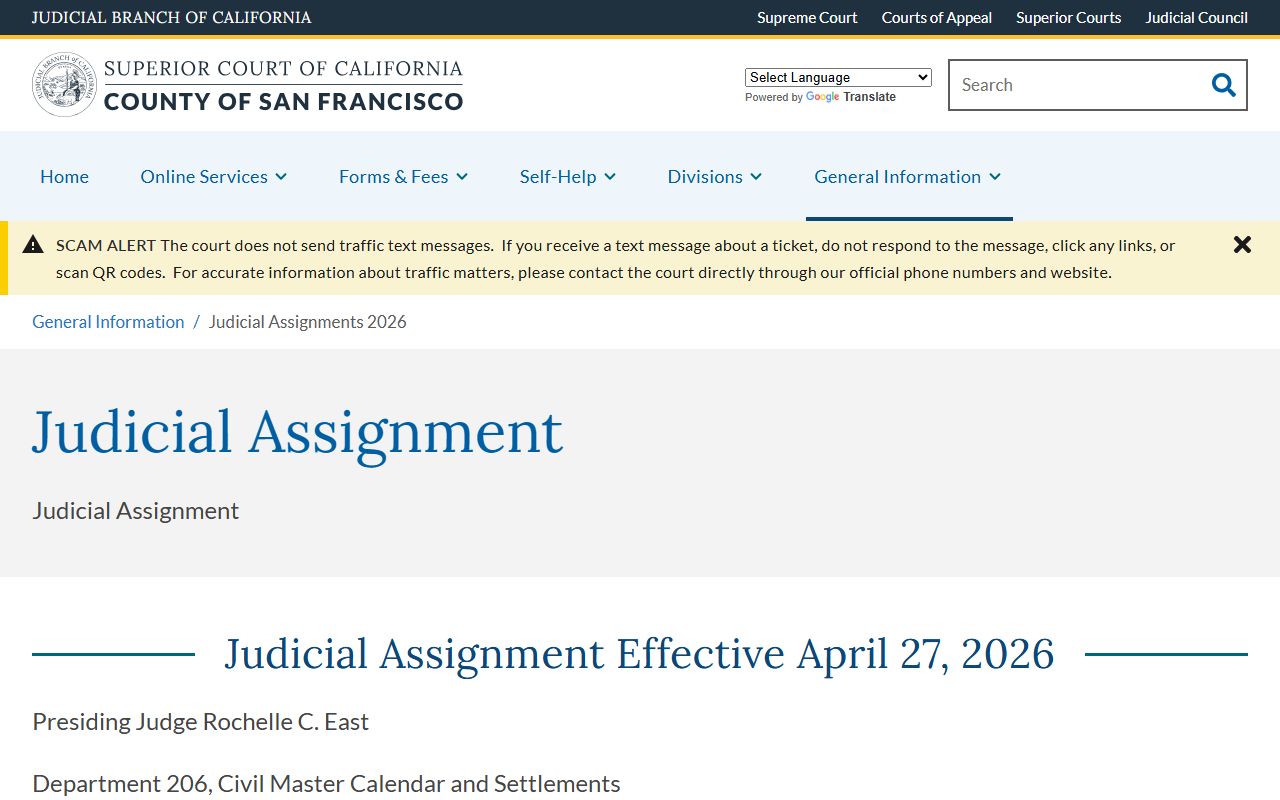
Verify the current judge before relying on a docket entry's department number for a San Francisco County court records call.
Lower Courts and Why San Francisco Has None
San Francisco has no justice of the peace court, no county court at law, no city court, and no municipal court. California's unified trial court replaced those layers when Proposition 220 took effect in 1998. Every local case begins in Superior Court. The closest thing to a lower court is the Community Justice Center, but that is a specialty calendar of the Superior Court rather than a separate court.