
Criminal Records in San Francisco County
Criminal records in San Francisco County come from three offices. The San Francisco Sheriff's Office books people into custody under Sheriff Paul Miyamoto. The San Francisco Police Department handles arrests and the SFPD Most Wanted page. The Superior Court Criminal Division at the Hall of Justice creates the case file once charges are filed.
An arrest is not a conviction. A booking record means a person was taken in at County Jail #1. A court record starts when the DA files a charge. A conviction record means a judge or jury found the person guilty, or the person entered a guilty or no contest plea.
Infractions, misdemeanors, and felonies all appear in the criminal index. Misdemeanors bring a fine or up to a year in county jail. Felonies can bring state prison time. Specialty calendars run inside the criminal system: Mental Health Court in Department 15, Young Adult Court in Department 26, and Drug Court and Veterans Court at the Community Justice Center on Polk Street.
The court explains how the criminal track moves from arraignment to sentencing on a single division page. The Criminal Division page covers felony, misdemeanor, arraignment, and bail steps in San Francisco.
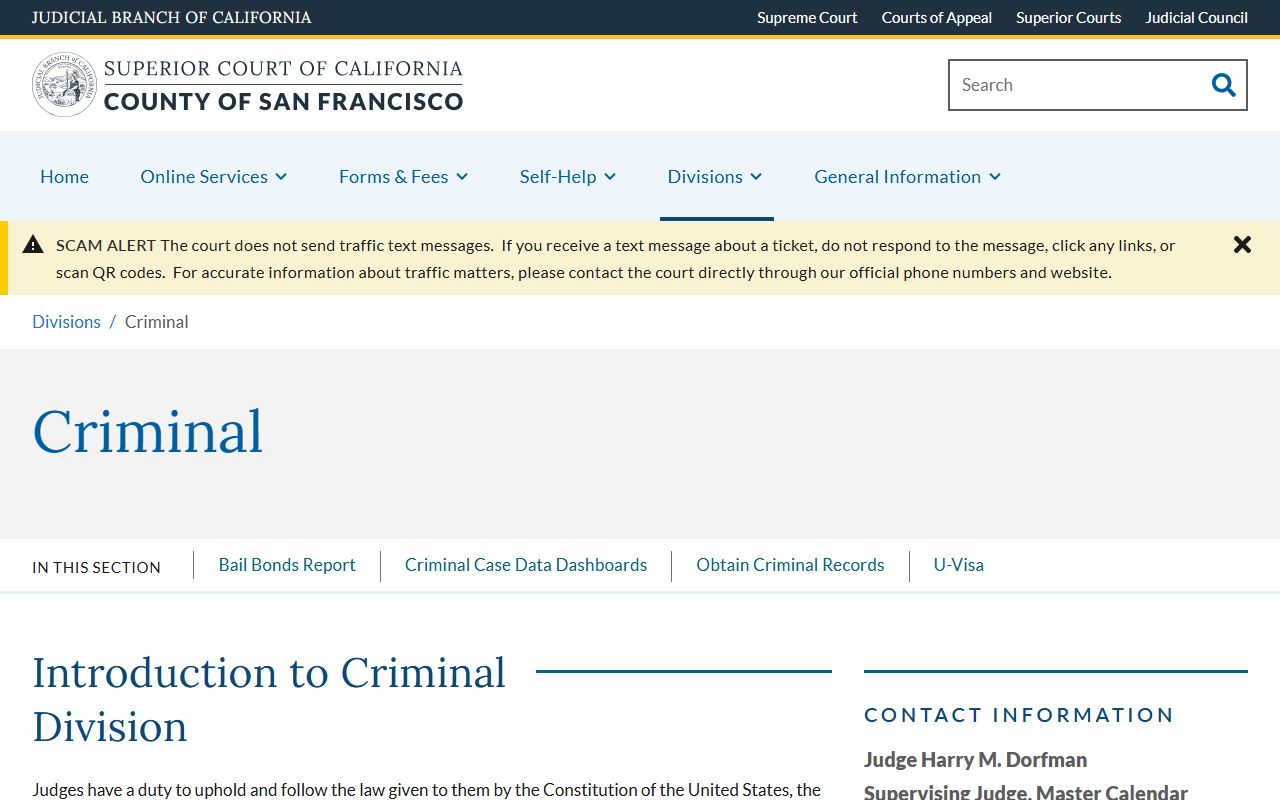
Read the Criminal Division page before walking into the Hall of Justice for a San Francisco County criminal records lookup.
How to Search San Francisco County Criminal Records
The court runs two free portals for criminal case lookups, both behind a captcha gate. The first is the Superior Court Criminal Case Query. The second is the cumulative criminal index. Use the query when a case number, defendant name, or attorney name is known. Neither portal shows imaged documents. The court's records page states that criminal records are not viewable online.
- Start at the official Case Information page. Pick the criminal query link.
- Pass the captcha gate.
- Enter a defendant name in last-name, first-name format, or type the case number. Attorney name search is also allowed.
- Note the case number, department, next hearing date, and disposition before closing the window.
- For copies or viewing, take the case info to the Criminal Records office at Hall of Justice Room 101, windows 7 or 8. Mail requests work too, with payment and a SASE.
The court Calendar tool pulls criminal hearings up to 120 days out, which helps confirm the right case when names overlap.
Arrest Records vs Criminal Court Records
An arrest record starts at booking. The Sheriff's Find a Person in Jail tool shows current custody but drops the person from results after release. A court record starts later, when the DA files a charge and the clerk opens a case. The case file holds pleadings, motions, orders, and the disposition.
| Arrest Record | Criminal Court Record | |
|---|---|---|
| Source | Sheriff or SFPD | Clerk of the Superior Court |
| Created When | Booking at County Jail #1 | When charges are filed |
| Contents | Booking number, statute, bond, age, facility | Pleadings, motions, orders, plea, disposition |
| Where to View | Sheriff inmate locator, public info line 415-553-1430 | Hall of Justice Room 101, windows 7 or 8 |
| Online Access | Current custody only | Case query, no imaged documents |
Note: The Sheriff's inmate locator does not include a mugshot or pod number, and the public JSON does not show race, sex, or medical flags.
Charges vs Convictions
Being charged is not the same as being convicted. A charge means the DA filed a complaint and a judge found probable cause. A conviction means the case ended in a guilty verdict, a guilty plea, or a no contest plea. Many cases end in dismissal, diversion, or a plea to a lesser count. Read the disposition line, not just the opening charge.
| Charge | Conviction | |
|---|---|---|
| Stage | Accusation by the DA | Verdict or plea |
| Burden of Proof | Probable cause | Beyond a reasonable doubt |
| Public Record | Yes, in the case file | Yes, in the case file |
| Outcome Field | Pending, dismissed, or held over | Guilty, no contest, or set aside |
| Relief Path | Penal Code 851.91 or 851.93 sealing if no conviction | Penal Code 1203.4 dismissal after probation |
Background screeners often confuse the two. A record can list a felony charge that ended in a misdemeanor plea. The case query shows the full path in the register of actions.
Sealed vs Expunged Records in California
California uses several tools the public calls "expungement," but they are not the same. Some seal an arrest. Some dismiss a conviction. Some destroy the file. The San Francisco Public Defender's Clean Slate Program at voicemail 415-553-9337 helps eligible residents pick the right path and file the petition.
| Sealed | Expunged / Dismissed | |
|---|---|---|
| Visibility | Hidden from public view | Conviction marked dismissed under Penal Code 1203.4 |
| Law Enforcement | Limited access stays | Court and DOJ can still see the prior |
| Eligibility | Arrest with no conviction under Penal Code 851.91; automatic relief under 851.93; factual innocence under 851.8 | Conviction after probation or sentence is complete under Penal Code 1203.4 |
| Effect | Records sealed; 851.8 can destroy arrest records | Case stays on record but reads as dismissed |
| Where to File | Court where the arrest was made or the case was filed | Court where the conviction occurred |
Penal Code 851.8 is the strongest path; it needs proof of factual innocence and can lead to full record destruction. Penal Code 851.91 covers arrests that did not lead to a conviction. Penal Code 851.93 gives automatic relief through the California DOJ. Penal Code 1203.4 dismisses a conviction after probation. None of these wipe out every trace.
The dismissal statute most users mean by "expungement" is set out in plain text on the state's code site. The Penal Code section 1203.4 page lists eligibility, the petition steps, and the limits of post-probation relief.
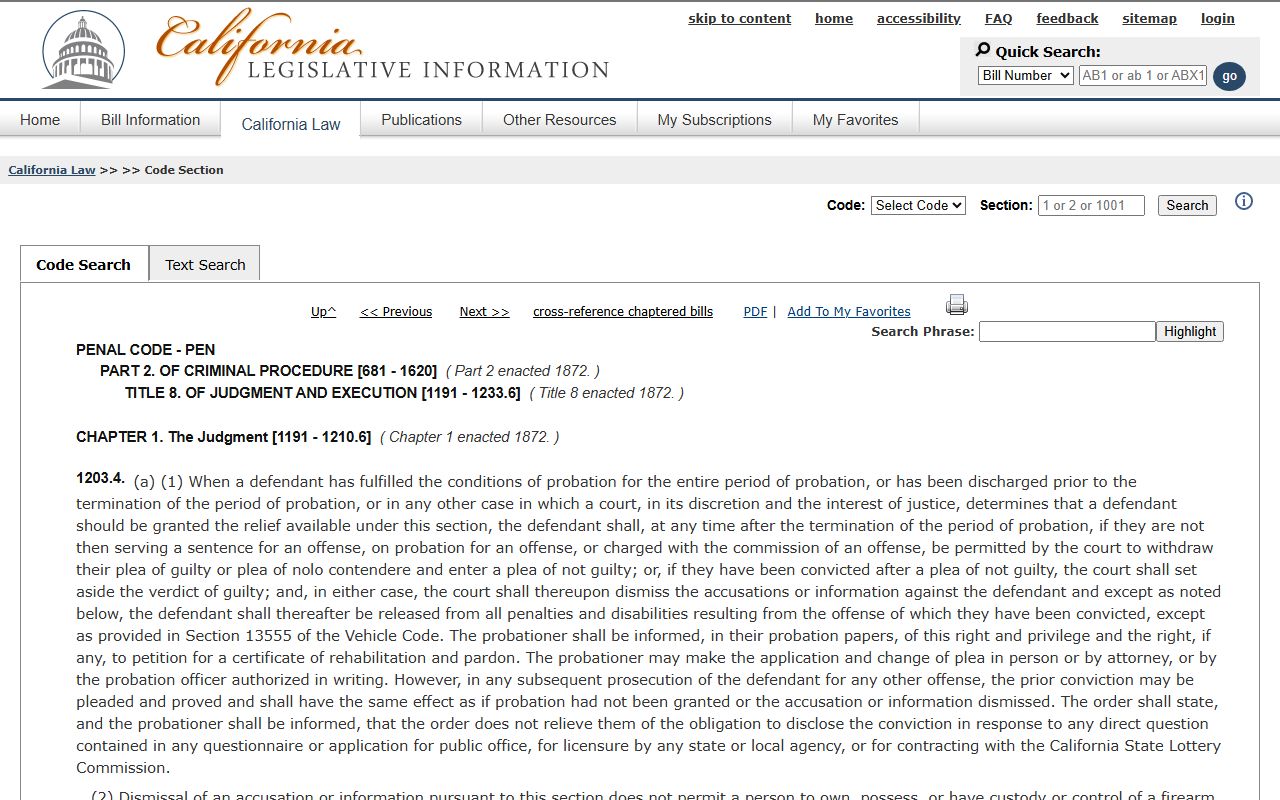
Pair this statute text with the local Clean Slate Program before filing any San Francisco County criminal record relief petition.
Note: Relief under 1203.4 does not restore firearm rights, end sex registration duties, or block disclosure for some state license applications.
Criminal Records Request Form Fields
The court's request form is a short PDF the clerk uses to find the file. The more fields filled in, the faster the search. Mail must include payment and a SASE. A blank case number is fine if the defendant name and arrest date are clear.
| Field | Type | Notes |
|---|---|---|
| Defendant Name | text | Full legal name. Required if no case number is given. |
| Case Number | text | Best single identifier. Cuts delay. |
| Citation Number | text | Use for citation-linked criminal matters. |
| Search Warrant Number | text | For known warrant records. |
| Date of Arrest | date | Narrows by booking window. |
| Date of Birth | date | Helps split common names. |
| Type of Copy or Record | checkbox | Viewing, plain copy, certified copy, docket, or specific filings. |
| Requestor Name and Address | text | Required for mail return. |
| Payment | check, money order, in person | Mail must include payment. |
The form sits on the court's Criminal Records Request Form page as a fillable PDF.
Hall of Justice Criminal Records Office
The criminal records counter is the main intake for in-person requests. Walk-ins, mail requests, and pickups all go through the same office. Larger copy requests can take 12 to 15 court days.
Criminal Records Office, Superior Court of California, County of San Francisco
Hall of Justice
850 Bryant Street, Room 101, Windows 7 and 8
San Francisco, CA 94103
Phone: 415-551-0651
Hours: Monday through Friday, 8:30 a.m. to 4:00 p.m., closed noon to 1:00 p.m.
Mail: Attn: Records Dept., 850 Bryant Street, Room 101, San Francisco, CA 94103
Mail requests should include a check or money order, a self-addressed stamped envelope, and as many identifying fields as the form asks for.
Criminal Records Fees
Copy fees are set by court rule and state schedules. The structure mirrors the civil side. Certified copies cost more than plain copies, and exemplified copies take longer.
| Item | Fee |
|---|---|
| Plain copy, per page | $0.50 |
| Certified copy | Listed on Criminal Records Request Form; verify current fee |
| Exemplified copy | Longer processing, 12 to 15 working days |
| File viewing only | No charge; valid ID held at the counter |
| Mail copy request | Pay by check or money order; include SASE |
| Online criminal case query | Free; captcha required |
Government Code 7922.575 caps agency duplication costs to direct cost unless another statute applies. That rule covers agency records like police reports, not court files. Court copy fees follow court rule.
Mugshots and Booking Photos
Mugshot access in San Francisco is narrow. The Sheriff's inmate locator does not display a booking photo, and no mugshot field appears in the public JSON. SFPD posts photos of select fugitives on its Most Wanted page, but that is a curated list, not a full mugshot database.
People who need a booking photo for a legal purpose should ask through a defense attorney or a records request to the arresting agency. Under Government Code 7923.600, law enforcement may withhold investigatory records during an open case.
Note: A mugshot is not an indicator of guilt; many booking photos belong to people whose cases later end in dismissal.
The District Attorney and Public Defender
San Francisco's elected District Attorney is Brooke Jenkins, sworn in as the 31st DA on January 8, 2023. The DA's Office charges cases and runs the Sentencing Commission. A case the DA declines does not become a court file, but the arrest entry still exists.
The elected Public Defender is Mano Raju, the only elected Public Defender in California. The downtown office sits at 555 7th Street, San Francisco, CA 94103, phone 415-553-1671. The Youth Defender office is at 375 Woodside, phone 415-753-7601. The judge tells defendants at arraignment that the court will appoint counsel free of charge if they cannot afford a lawyer.
The Public Defender's Clean Slate Program is the main local resource for record cleaning. The voicemail line is 415-553-9337. Staff check eligibility, prepare petitions under Penal Code 1203.4 or 851.91, and walk clients through the hearing.
The DA's office posts its leadership bio and case priorities on its own site. The San Francisco District Attorney about page features DA Brooke Jenkins's biography.
Charging decisions on every San Francisco County criminal case begin in the DA's office and shape what ends up in the court record.
The Public Defender's site lists the elected office leader and the Clean Slate Program. The Mano Raju biography page shows the elected Public Defender's background and contact info.

For free help with eligibility under Penal Code 1203.4 or 851.91, call the Clean Slate Program from the Public Defender's office.
Statewide Criminal History Searches
The California Department of Justice keeps the state criminal history database. A person can request their own record through the DOJ live scan process. Third parties cannot pull a full California criminal history. Penal Code 851.93 directs the DOJ to apply automatic relief for some eligible arrests, which can change what a state rap sheet shows.
For state prison custody, the CDCR inmate locator shows current and historical status. For federal custody, the BOP inmate locator covers federal prisons. For sex offender status, California Megan's Law is the public registry.
Background Check Considerations
Employers, landlords, and insurance carriers must use an FCRA-compliant consumer reporting agency for any background check that drives a hiring, housing, credit, or insurance decision. Casual online lookups do not meet that bar. A record showing dismissal under Penal Code 1203.4 should be read as a dismissed case, not a current conviction.
Important: San Francisco County Court Records is a private informational resource and is not a consumer reporting agency under the FCRA; the data on it cannot be used to make any FCRA-regulated decision.
Restricted Criminal Records in San Francisco County
Some criminal files are not open to the public. Juvenile delinquency and dependency files are restricted under Welfare and Institutions Code 827. Parties, attorneys, child welfare staff, and probation officers can see them; others need a court order. Sealed adult arrest files under Penal Code 851.91 are also kept from public view. Court-sealed records under California Rules of Court 2.550 and 2.551 require a judge's findings.
Mental health filings are another restricted layer. Department 15 handles Behavioral Health Court, Mental Health Court, and Mental Health Diversion. Those files often hold medical data shielded by statute. Search warrants can have sealed portions under Evidence Code 1040 to 1042 to protect informants. Open investigations may be held back under Government Code 7923.600.