
How to Search San Francisco County Court Records
The court keeps its public search tools on the Case Calendar and Query page. From there, users pick a path. The civil case query covers Unlimited Civil, Limited Civil, Family Law, Probate, and Small Claims cases by case number or party name. The criminal case query takes a case number, a defendant name, or an attorney name. A separate unlawful detainer query handles rental debt files for parties with access codes. There is also a cumulative criminal index updated weekly.
Before starting, gather what you have. A case number speeds things up. If only a name is known, the court's Name Query Page PDF says to use one of three formats: lastname; lastname, firstname; or company name. Civil registers go back to 1987. Imaged civil documents date from 2001 forward. Small claims images start in 2008. Family law images are not viewable online at all. Criminal documents are also not online and must be pulled in person at the Hall of Justice.
Every query path runs through a captcha gate before the form even loads. The civil case query captcha page is what users see first when opening the civil tool from the court site.
Solving that prompt is the only way to open the civil search form for a San Francisco County court records lookup.
- Open the Case Calendar and Query page on the Superior Court site rather than any third-party portal. It is the court-maintained index for every search tool.
- Pick the right path: civil for Unlimited or Limited Civil, Family Law, Probate, and Small Claims; criminal for criminal matters; UD/rental debt for parties with access codes; or calendar for upcoming hearings.
- Complete the captcha gate. The court uses it to confirm that a person, not a bot, is requesting case information. The same gate protects every query tool.
- Enter a case number when you have one. For a name search, use the format from the official PDF. Allow several seconds for large case files to load.
- Turn off pop-up blockers. Case data opens in a new browser window. The court also notes that a current PDF reader is needed to view document images.
- For family law, expect register-of-actions data only with the case number. For probate estate or trust matters, images run from 2001 forward; guardianship, conservatorship, and elder abuse images stay offline.
- For criminal records, plan an in-person trip to Hall of Justice Room 101 or mail a request to the Records Department at 850 Bryant Street.
San Francisco County Court Records Search Fields
Each Superior Court query tool exposes its own input set. The civil query takes a case number or a party name. The criminal query accepts case number, defendant name, or attorney name. The calendar tool runs on case type and date and shows up to 120 days from the current date. Because every tool sits behind a captcha gate, the field labels below come from the court's own pages and the official name query PDF. The court does not expose form options in the browser before the captcha is solved.
| Field Label | Type | Required | Notes / Format |
|---|---|---|---|
| Captcha prompt | anti-bot gate | Yes | Must be cleared before any query form loads. |
| Civil case number | text | Optional | Use when known; civil registers cover 1987 to present. |
| Civil party / case name | text | Optional | Format: lastname; lastname, firstname; or company name. |
| Criminal case number | text | Optional | Use when the case number is on a citation, bond receipt, or notice. |
| Criminal defendant name | text | Optional | Use the full legal name for cleaner results. |
| Attorney name | text | Optional | Permitted on the criminal query path only. |
| Case calendar date | date | Likely yes | Calendars run up to 120 days from the day of the search. |
| Case type | dropdown | Likely yes | Covers civil, criminal, probate, small claims, traffic, family, and specialty calendars. |
| Access Now | button | Yes | Submits the query and opens results in a new browser window. |
Types of San Francisco County Court Records
The Superior Court is a unified trial court. Since Proposition 220 took effect in 1998, California counties no longer run separate municipal, justice, district, or county courts. Every local case starts in Superior Court. That means civil, family, probate, small claims, criminal, traffic, juvenile, mental health, and specialty matters all sit under one court system. Each division has its own filing window, its own records desk, and its own access rules.
The Civic Center Courthouse at 400 McAllister Street holds civil, family, probate, traffic, and self-help services in Room 103 and on the 4th floor. The Hall of Justice at 850 Bryant Street holds the Criminal Division and the traffic counter. Juvenile matters move to the Juvenile Justice Center at 375 Woodside Avenue. The Polk Street Annex hosts the Community Justice Center for Drug Court and Veterans Court.
- Civil records include unlimited civil, limited civil, asbestos, civil harassment, civil petitions, name and gender change, defaults, case management, civil restraining orders, and appeals. Registers go online; some images are viewable from 2001.
- Criminal records cover infractions, misdemeanors, and felonies, plus arraignments, preliminary hearings, trials, motions, probation, bail events, and record cleaning. Criminal documents are not online.
- Family law records include divorce, legal separation, annulment, custody, visitation, child support, parentage, and domestic violence restraining orders. Family law imaged documents are not viewable online.
- Probate records cover wills and decedents' estates, trusts, guardianships, conservatorships, and elder abuse cases. Estate and trust images are online from 2001 forward.
- Small claims records cover lower-dollar disputes, with imaged documents available online from 2008.
- Traffic and infraction records move through Room 145 at the Hall of Justice; parking citations are not court records and go to the SFMTA instead.
- Juvenile, adoption, and dependency files are restricted by state law and require party status, statutory authority, or a court order.
What San Francisco County Court Records Show
A San Francisco County court record is more than a single document. It is a case file with a register of actions, parties, hearing dates, filed documents, orders, and a final disposition. The Superior Court releases part of that file online and keeps the rest in paper or restricted electronic form. Mini-minutes, sealed documents, and confidential matters never appear in the public portal. The Civil Records Department in Room 103 of the Civic Center Courthouse holds files for in-person viewing on a first-come basis.
The table below lists the data fields a public case record typically returns. Field availability shifts by case type. Civil and probate cases tend to be the richest. Family law cases hide the most. Criminal cases give back register entries and event data, but no images.
| Field | What It Shows |
|---|---|
| Case Number | The court's tracking ID. Civil and probate searches start here; criminal queries take it too. |
| Case Title | Plaintiff vs defendant for civil, or estate or trust name for probate. |
| Filing Date | Date the case opened with the Superior Court Clerk. |
| Case Type | Civil, family, probate, small claims, criminal, traffic, juvenile, or specialty docket. |
| Parties | Plaintiffs, defendants, petitioners, respondents, decedents, minors, or protected persons subject to redaction rules. |
| Register of Actions | Chronological list of filings, hearings, orders, judgments, and minute entries. |
| Hearing Calendar | Upcoming dates, departments, and case types for the next 120 days. |
| Documents | Imaged filings where allowed; civil from 2001, small claims from 2008, probate estate or trust from 2001. |
| Disposition | The final outcome: judgment, dismissal, plea, verdict, or settlement. |
| Financial Fields | Civil filing fees, bail or bond amounts, restitution, court costs, and copy fees as applicable. |
A few common terms come up in nearly every San Francisco County court record. A plaintiff starts a civil case. A defendant is the party sued or charged. A petitioner files a petition in family, probate, or restraining order matters. The register of actions is the case timeline. A motion is a written request for an order. A judgment is the final ruling. A disposition is the outcome of a case or a single charge. Bail is the cash or condition that secures release; a bench warrant is issued after a failure to appear.
Public Access Framework for San Francisco County Court Records
California court records run on two different tracks. Case files follow court rules, common-law access principles, and case-specific privacy statutes. Administrative court records, like budgets and policies, follow California Rules of Court rule 10.500. Records held by other agencies, such as the Sheriff or the Police Department, fall under the California Public Records Act at Government Code section 7920.000 and the broad-access principle at section 7922.000. The court's own records page warns that the rule 10.500 form is for administrative records only and should not be used for case records.
Electronic case records have their own rule set. California Rules of Court rule 2.400 sets up the framework for electronic access. Rules 2.500 through 2.507 spell out remote access limits. Government Code section 68150 backs court management of records in paper and electronic form. CPRA timing rules also help. Agencies must decide within 10 days whether disclosable records exist under Government Code 7922.535. Copy fees come from section 7922.575.
For court copies, San Francisco's own timing rules apply. Larger civil copy requests may take 12 to 15 court days. Plain copies run $0.50 per page on the Civil Records Request Form. Criminal copies use a separate request form and accept payment by check or money order, with a self-addressed stamped envelope for mail. Anyone can ask, but identification rules apply and a deposit may be required for certain in-court file viewings.
The court lays out which case types are online, which are in person, and which require a court order. The Superior Court records page shows the access table the public uses to pick a path.
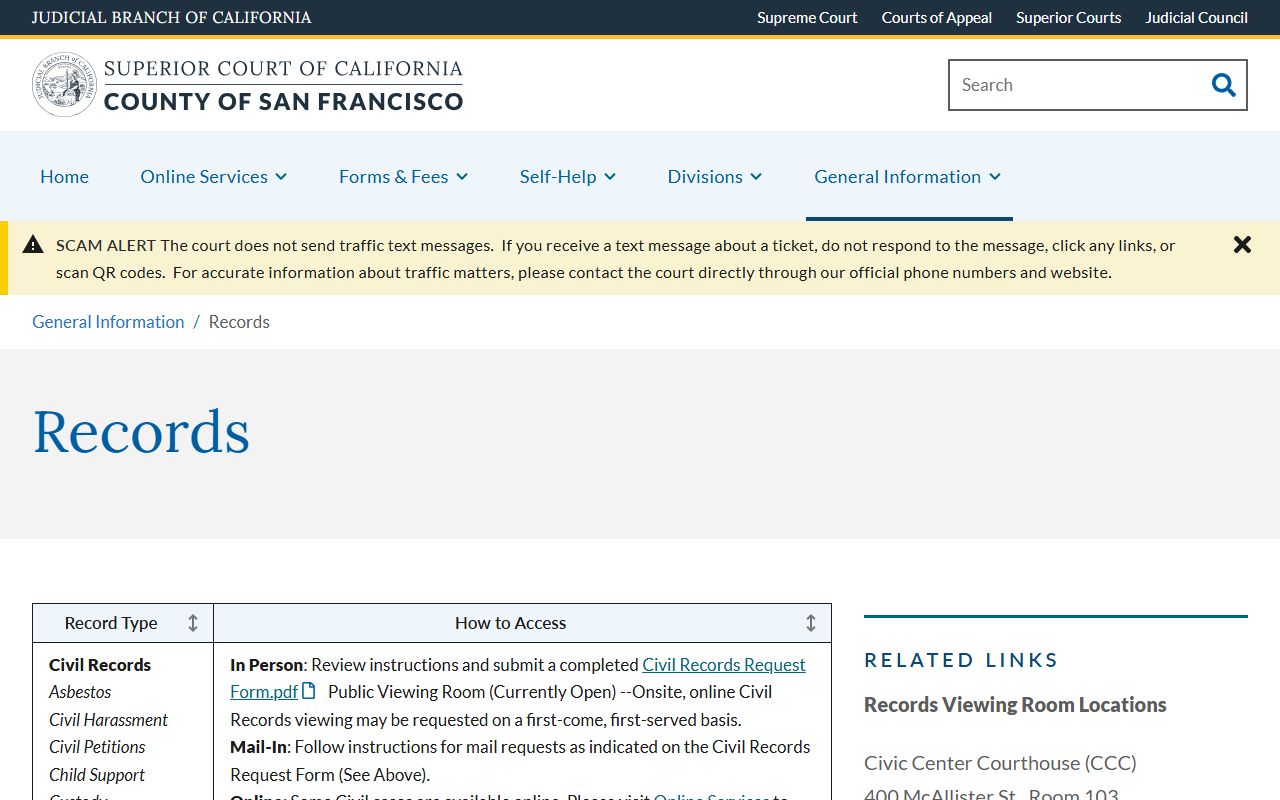
That table is the official starting point for any San Francisco County court records request and predates any third-party portal.
Note: Public access is broadly favored under California law, but court rules can still bar online posting of records that may be inspected in person at the courthouse.
Records That Are Sealed or Confidential in San Francisco County
Some San Francisco County court records are off limits to the public, even on the in-person side. Juvenile case files fall under Welfare and Institutions Code section 827. Adoption records are confidential under Family Code section 9200. Sealed civil records require a court order under California Rules of Court rule 2.550, with the sealing procedure in rule 2.551. Probate has its own rules; the Superior Court records page says non-parties need advance approval from the Probate Department in Room 202 to view confidential files, with the contact line at 415-551-3650.
California offers several record-relief paths that the public often groups under the word "expungement." Under Penal Code section 1203.4, eligible people can ask the court to dismiss a conviction after probation. Under Penal Code section 851.91, an arrest that did not lead to a conviction can be sealed. Penal Code section 851.93 provides automatic relief for some arrests. Penal Code section 851.8 covers factual-innocence sealing and later destruction. The Criminal Division's "Cleaning Up Your Record" section directs users to court self-help and the Public Defender's Clean Slate Program.
To view a sealed file, a member of the public must move to unseal under rule 2.551. The motion must explain why the original sealing should be lifted and serve notice on the parties. Sensitive family law materials, child custody evaluations, domestic violence filings, and financial disclosures are not online and may be partly restricted in person. Mental Health Court, Behavioral Health Court, and Mental Health Diversion files at Department 15 can include medical content and may be limited even further.
In-Person Court Record Requests
For civil, family, probate, small claims, and unlawful detainer files, the public goes to Room 103 of the Civic Center Courthouse. The court takes requests in person and by email at CCCRecordsDepartment@sftc.org. Criminal records sit at the Hall of Justice at 850 Bryant Street, Room 101, windows 7 and 8. Building hours run Monday through Friday, 8:15 a.m. to 5:00 p.m., with the filing clerk windows open 8:30 a.m. to 4:00 p.m. and closed for lunch from noon to 1:00 p.m.
Bring a photo ID, a list of the cases or documents wanted, and a payment method. The court accepts checks or money orders by mail and may take cash, card, or check in person. For longer copy orders, plan 12 to 15 court days for larger civil pulls. Files in use by the court that day cannot be viewed until they are returned.
Civil walk-in requests, file viewing, and copy orders go through Room 103. The Civil Records Department page shows the Room 103 address, the email for record requests, and the public hours.
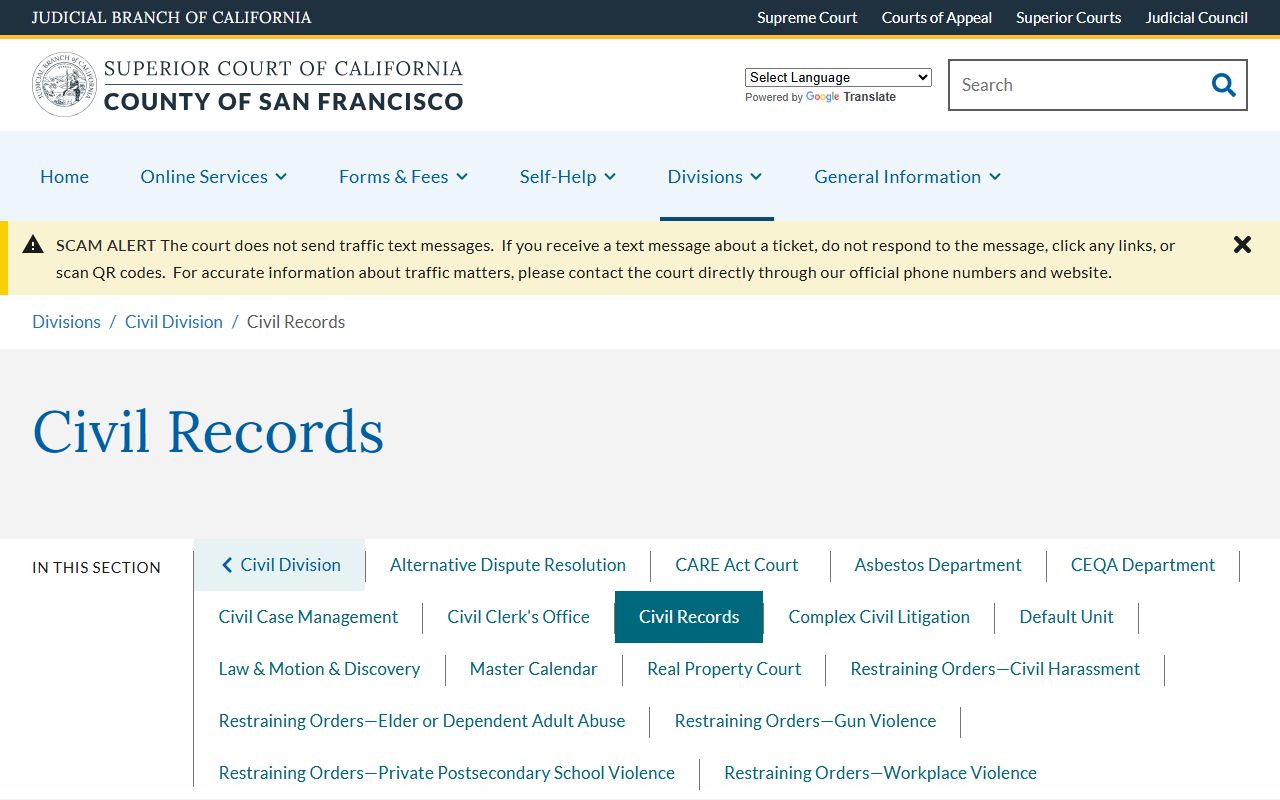
Confirm the hours on that page before heading downtown to pull a San Francisco County court record in person.
Superior Court Civil Records
400 McAllister Street, Room 103
San Francisco, CA 94102
415-551-3802
Mon-Fri 8:30 a.m.-4:00 p.m. (closed noon-1 p.m.)
Superior Court Criminal Records
850 Bryant Street, Room 101
San Francisco, CA 94103
415-551-0651
Mon-Fri 8:30 a.m.-4:00 p.m.
Record Request Forms and Fees
The court ships two record request forms. The Civil Records Request Form covers civil, family, probate, small claims, and unlawful detainer matters. The Criminal Records Request Form covers criminal cases. The criminal form has its own fields for citation number, search warrant number, and date of arrest, which speeds up search by reducing the load on staff. Both forms ask for the requestor's name, address, and phone. Both ask whether you want plain copies, certified copies, or only file viewing.
A quick fee table for court and Recorder services is below. Court copy and certification fees are listed on the request forms; verify the exact current amount before sending payment.
| Item | Fee |
|---|---|
| Civil plain copies | $0.50 per page |
| Civil certification | Listed on form; verify current rate |
| Exemplified copies (longer processing) | 12-15 court days |
| Certified public marriage certificate (Recorder) | $17 per copy |
| Recorder document self-service copy | $1.81 per document |
| CPRA copies from non-court agencies | Direct duplication cost unless another statute applies |