
California Public Records Act Framework
The California Public Records Act sets the rules for agency records in San Francisco County. The Act was recodified into Division 10 of Title 1 of the Government Code, effective January 1, 2023. The naming provision sits at Government Code section 7920.000. Under section 7922.000, public access is broadly favored. An agency can only hold back a record if a specific exemption in the Act or another law applies. That covers Sheriff, DA, SFPD, County Clerk, Assessor-Recorder, and most other city and county offices.
The CPRA is not the only access law in play. Court case files in San Francisco are run under court rules and case law, not the CPRA. Judicial administrative files, the kind that cover budgets, policies, and court operations, are run under California Rules of Court rule 10.500. The court's own records page warns that the rule 10.500 form should not be used for case records. San Francisco is a consolidated city and county, so one charter covers both city and county functions, and most public records sit with city departments rather than a separate county records office.
The state code names the Act and sets the framework in plain text. The Government Code section 7920.000 page is the statutory naming provision for the California Public Records Act.
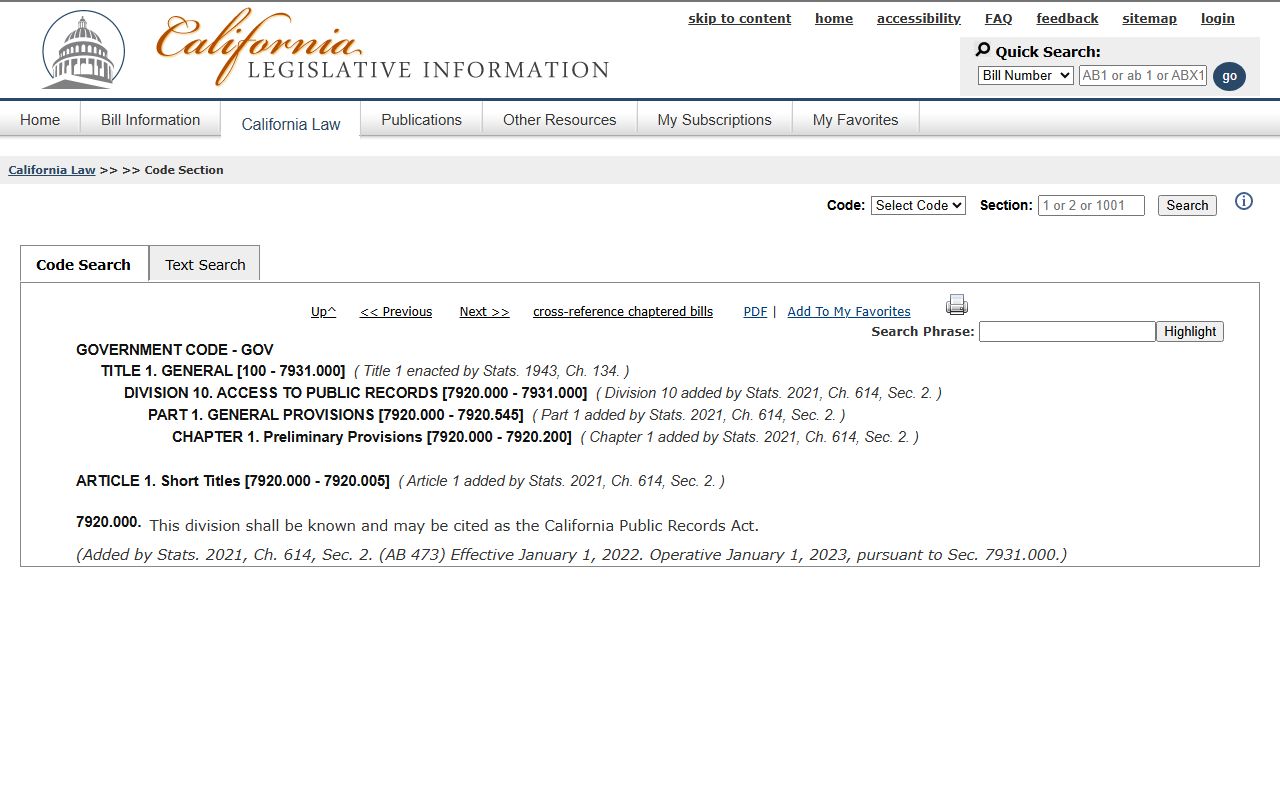
Cite this section when filing a San Francisco County public records request to a city or county agency.
Three Tracks for San Francisco County Public Records
The same words, public records, point at three different files in San Francisco. A clear request names the track first. The three tracks are court case records, judicial administrative records, and agency records under the CPRA. Each one is filed in a different office and uses a different form.
Court case records come from the Superior Court. Civil, family, probate, and small claims case requests go through the Civil Records Department at 400 McAllister Street, Room 103. Criminal case records go through Hall of Justice, 850 Bryant Street, Room 101, windows 7 or 8. The court charges $0.50 per page for plain civil copies and may take 12 to 15 court days for larger orders. Court files are not CPRA records, even though they are public. Judicial administrative records cover court policy, budget, and operations files under rule 10.500. Agency CPRA records, the third track, cover everything held by city and county agencies that are not the court. That last track is the one most users mean when they say public records.
Which San Francisco County Agency Keeps Which Records
San Francisco does not have a single county records office. Files sit with the agency that made them. Marriage license filings, fictitious business names, notary filings, domestic partnerships, and City IDs are at the Office of the County Clerk in San Francisco City Hall, Room 160. Recorded property documents, deeds of trust, liens, maps, and public marriage certificates are at the Office of the Assessor-Recorder. The current Assessor-Recorder is Joaquin Torres. Sheriff jail data and booking files are at the Sheriff's Office. Police reports come from the San Francisco Police Department. Charging files, sentencing data, and DA policy material come from the District Attorney's Office.
- Sheriff: jail roster, booking and release logs, jail population data, and Sheriff policy files.
- District Attorney: charging policy, sentencing commission material, and prosecution records that are not part of a sealed court file.
- San Francisco Police Department: incident reports, calls for service, body-worn camera releases, and SFPD General Orders such as General Order 5.16 on search warrants.
- County Clerk: marriage licenses, confidential marriage filings, domestic partnerships, City IDs, fictitious business names, and notary filings.
- Assessor-Recorder: deeds, deeds of trust, liens, reconveyances, maps, and public marriage certificates.
For court case files, go to court records or the Clerk of the Superior Court page. For charging and arrest data, go to criminal records. For marriage and divorce filings, go to marriage and divorce records.
Free Online Recorded Documents from 1990 Forward
In late 2024, the Assessor-Recorder launched a free online service for recorded documents. A December 23, 2024 press release from the office says the new tool lets the public view recorded documents from 1990 to the present at no cost. The release puts the total at more than 7 million unique documents, with about 2.25 million older files from 1990 to 2000 added in the rollout. The office also called it a first-in-the-state service.
That free view covers recorded items only. Deeds, deeds of trust, liens, reconveyances, maps, and public marriage certificates are typical. A certified copy still has a fee. The Assessor-Recorder fee schedule lists a $1.81 flat self-service web copy and a $17 certified copy for a public marriage certificate. The free view is read-only. To get a stamped or certified file, the request still goes through the Recorder's normal channels.
How to File a San Francisco County Public Records Request
A CPRA request can be spoken or written, but a written request creates a paper trail and is easier to track. The steps below cover the common path for a San Francisco County agency record. Court case records use the court's own forms, not these steps.
- Pick the right office. Decide whether the record is a court case file, a judicial administrative file under rule 10.500, or an agency file under the CPRA. Each one uses a different form and a different point of contact.
- Describe the records with care. Name the record type, the date range, the parties, and any case or file number. Government Code 7922.530 says agencies must help requesters frame focused requests, so a phone call to the office can save time.
- Submit by the agency's accepted channel. Many departments accept email, online portal, mail, or in-person delivery. The County Clerk takes some requests at City Hall, Room 160. The Assessor-Recorder takes recorded-document requests by mail or web. The Sheriff and SFPD use department forms.
- Wait for the 10-day determination. Government Code 7922.535 says an agency must decide within 10 days whether it has disclosable records, with limited extensions. That decision is not the delivery date, just the answer on whether records exist and will be released.
- Pay any direct copy fee under Government Code 7922.575. The agency can charge the direct cost of duplication unless another statute sets a different fee. Recorder and court fees follow their own schedules.
- Pick up the records or get them by mail or email. For mail responses, agencies often ask for a self-addressed stamped envelope. For court copy requests, plan on 12 to 15 court days for large orders, per the Civil Records page.
Note: The 10-day CPRA window is the determination period, not the file delivery date, and the court's case-record copy timing is separate from the CPRA clock.
The agency response-time rule is its own code section. The Government Code section 7922.535 page sets the 10-day window for an agency determination.
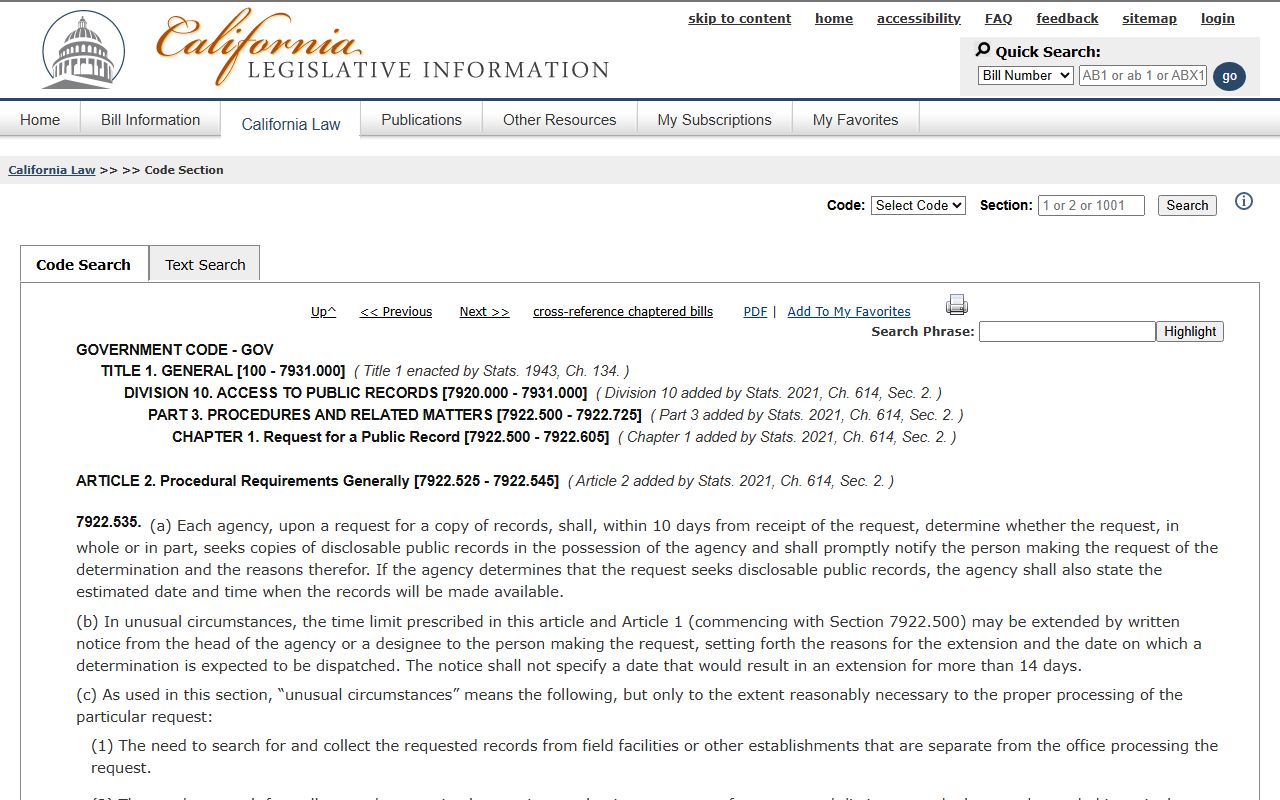
Quote this section if a San Francisco County agency misses the 10-day determination window on a public records request.
Public Records Request Form Fields
San Francisco has more than one request form. The Superior Court uses a Civil Records Request Form for civil, family, probate, small claims, and judgment work, and a separate Criminal Records Request Form for criminal files. CPRA agency forms vary by department but ask for the same kind of detail.
| Field | Required | Notes |
|---|---|---|
| Name | Yes | Requestor contact section. |
| Agency, if applicable | No | For agencies or law firms. |
| Mailing Address | Yes | Used for mail return. |
| Phone Number | Yes | Contact for questions on the request. |
| Date of Request | Yes | Date the form is signed. |
| Case Name | Requested | Short title or party names. |
| Case Number | Requested | Important to avoid delays. |
| Judgment Book and Page Number | No | For judgment research. |
| Type of Record Requested | Yes | Civil, family, probate, small claims, UD, or specific document. |
| Plain Copies | No | $0.50 per page, with subtotal lines. |
| Certified Copies | No | Certification fee line on the form. |
| Exemplified Copies | No | Longer processing, 12 to 15 working days. |
| Search or Viewing Only | No | Use when no copy is needed. |
| Date and Short Title of Document(s) | Requested | Identify filings, orders, judgments, or minute orders. |
| Requestor Signature | Yes | Confirms the request. |
The Criminal Records Request Form is filed at Hall of Justice, Room 101, by mail or in person.
| Field | Required | Notes |
|---|---|---|
| Defendant Name | Required if no case number | Use the full legal name. |
| Case Number | No, but preferred | Reduces delays. |
| Citation Number | No | For citation-linked matters. |
| Search Warrant Number | No | Specific to warrant records. |
| Date of Arrest | No | Narrows the search. |
| Date of Birth | No | Helps tell defendants apart. |
| Requestor Name | Yes | Contact. |
| Mailing Address | Yes for mail | Include a self-addressed stamped envelope for mail. |
| Phone or Email | Requested | For clerk follow-up. |
| Type of Copy or Record | Yes | Viewing, copies, certified copies, docket, or specific documents. |
| Payment | Yes for copies | Include a check for mail requests. |
The forms themselves are posted on the Superior Court site as the Civil Records Request Form and the Criminal Records Request Form.
Response Timelines Under the CPRA
For agency records, the clock runs from the date the agency gets the request. Under Government Code 7922.535, the agency has 10 days to decide whether disclosable records exist. The Act allows a short extension when the request needs more work, such as a search across several offices, large file volumes, or a need to review records for exemptions. The 10-day mark is not the date the records arrive. Production can take more time, especially for older or paper-only files.
Court case copy timing is set by the court. The Civil Records page says larger civil copy orders can take 12 to 15 court days. Mailed orders need a self-addressed stamped envelope. Same-day copies are not promised. For very common files, on-site viewing in Room 103 may be quicker than a written copy order.
Public Records Fees in San Francisco County
Fees depend on which office holds the record. CPRA agency fees follow the direct duplication cost rule in Government Code 7922.575 unless another statute sets a special fee. Court fees are set by the court's local schedule. Recorder fees are set by the Assessor-Recorder schedule. The table below pulls the fees the research file confirms.
| Item | Amount |
|---|---|
| Civil plain copies, per page | $0.50 |
| Civil certification fee | Listed on the Civil Records Request Form; verify the current amount on file |
| Recorder self-service web copy, per document | $1.81 flat |
| Certified copy of public marriage certificate | $17 |
| Confidential marriage certificate copy | See County Clerk fee schedule |
| CPRA agency copies | Direct duplication cost unless another statute applies |
| Free online view of recorded documents, 1990 to present | $0 (read-only, no certification) |
The County Clerk fee schedule for marriage and confidential certificate work is posted at sf.gov. The Recorder Division's full fee schedule is posted on the Recorder fees page. Court fees and copy timing for civil files appear on the Civil Records page.
What Is Exempt from Public Release
The CPRA has many exemptions. The most common ones in San Francisco County come up in police, court, and family files. Law-enforcement investigatory files can be held back under Government Code 7923.600. That covers SFPD active cases, intelligence files, parts of arrest reports before they become court records, and warrant materials that have not been served. Juvenile case files are restricted under Welfare and Institutions Code 827. Adoption files are confidential under Family Code 9200.
On the court side, sealed civil records sit under California Rules of Court rule 2.550 and the sealing procedures in rule 2.551. Arrest-only records can be sealed under Penal Code 851.91 or 851.93, and factual innocence sealing sits at Penal Code 851.8. Family law imaged documents are not viewable online, and mental health, CARE Act, and conservatorship files often have extra limits. Notable exempt or limited categories in San Francisco County:
- SFPD active investigations and intelligence files under Government Code 7923.600.
- Juvenile delinquency and dependency files under Welfare and Institutions Code 827.
- Adoption records under Family Code 9200.
- Sealed civil and criminal files under California Rules of Court rules 2.550 and 2.551.
- Family law imaged documents and child-custody material, which are not online.
- Probate confidential filings, which need advance approval from the Probate Department in Room 202 of the Civic Center Courthouse.
The law-enforcement exemption keeps active investigation material out of public release. The Government Code section 7923.600 page sets the investigatory-record bar.
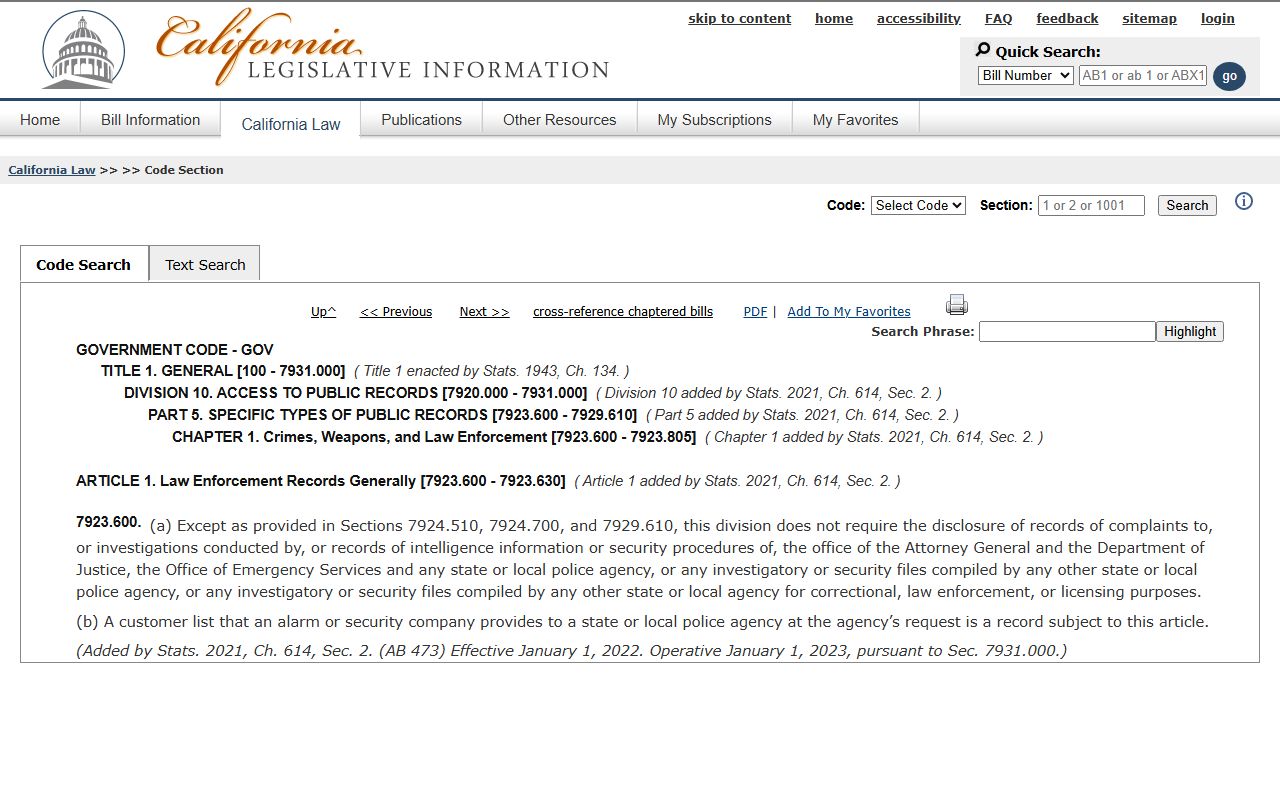
This exemption is the most common reason a San Francisco County police-records request gets a partial release.
The court rule on judicial administrative records is separate from the CPRA. The California Rules of Court rule 10.500 page covers court budget, policy, and operations files.
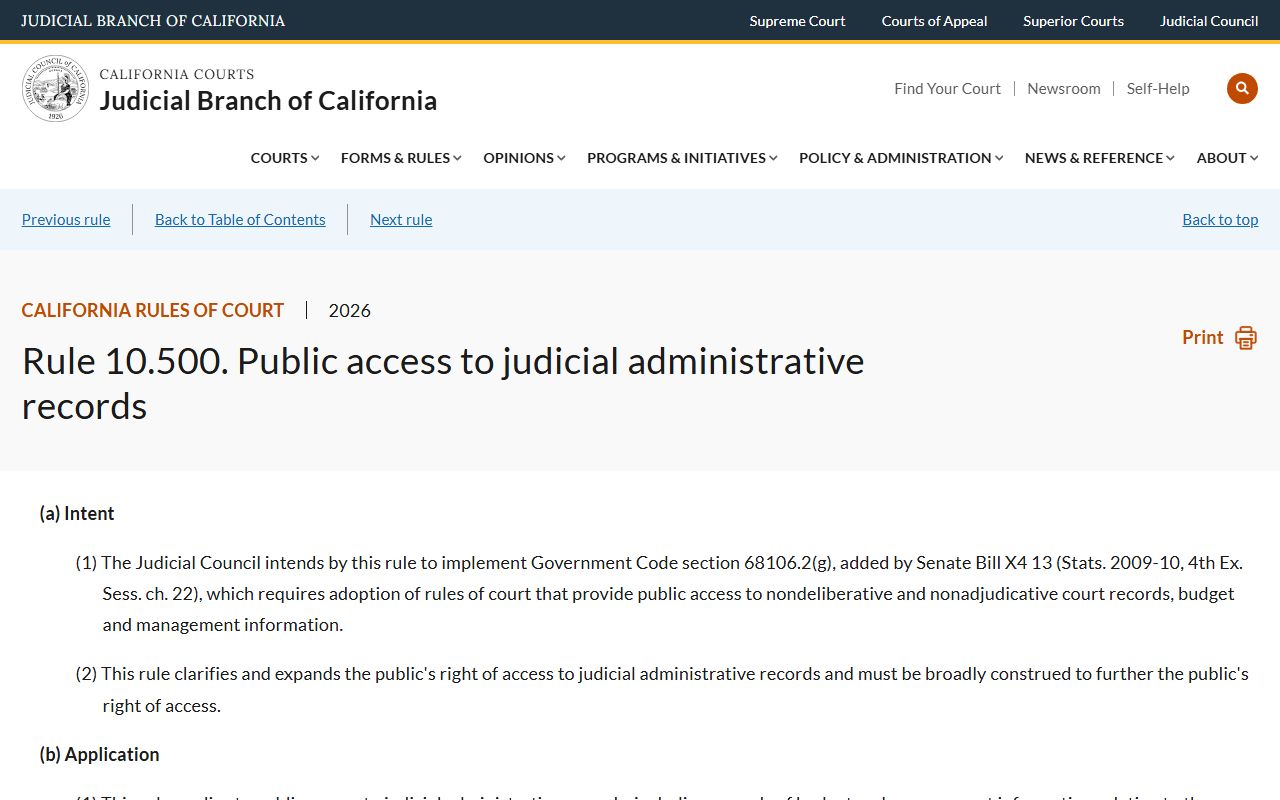
Use rule 10.500, not the CPRA, when asking for San Francisco County court administrative files rather than case files.
If a San Francisco County Public Records Request Is Denied
A denial under the CPRA is not the end. The agency must point to the exemption it relied on. The requester can ask for a written reason, narrow the request to drop the exempt part, or go to court for an order to disclose. California does not run a state attorney general complaint track for CPRA disputes the way some states do. The remedy is a civil suit in Superior Court. For court records, a denial often comes from the rule, not the office. Sealed files, family law images, and juvenile files cannot be released by the clerk. A motion to unseal under rule 2.551 is the route for sealed files.
Note: A CPRA suit must show the agency improperly withheld a record, and the prevailing requester can be awarded court costs and reasonable attorney fees.